So far I’ve written a lot of posts about how to predict the future. I used to think predicting the future was the whole point of thinking. Then something turned that idea upside down.
It was a paper I ran into by chance: What Makes Entrepreneurs Entrepreneurial?
Vinod Khosla liked it too. He’s one of the most influential VCs in Silicon Valley, an early investor in Google, Square, and DoorDash.

He wrote “First Good Paper I’ve Seen” on the cover and passed it around to his colleagues.
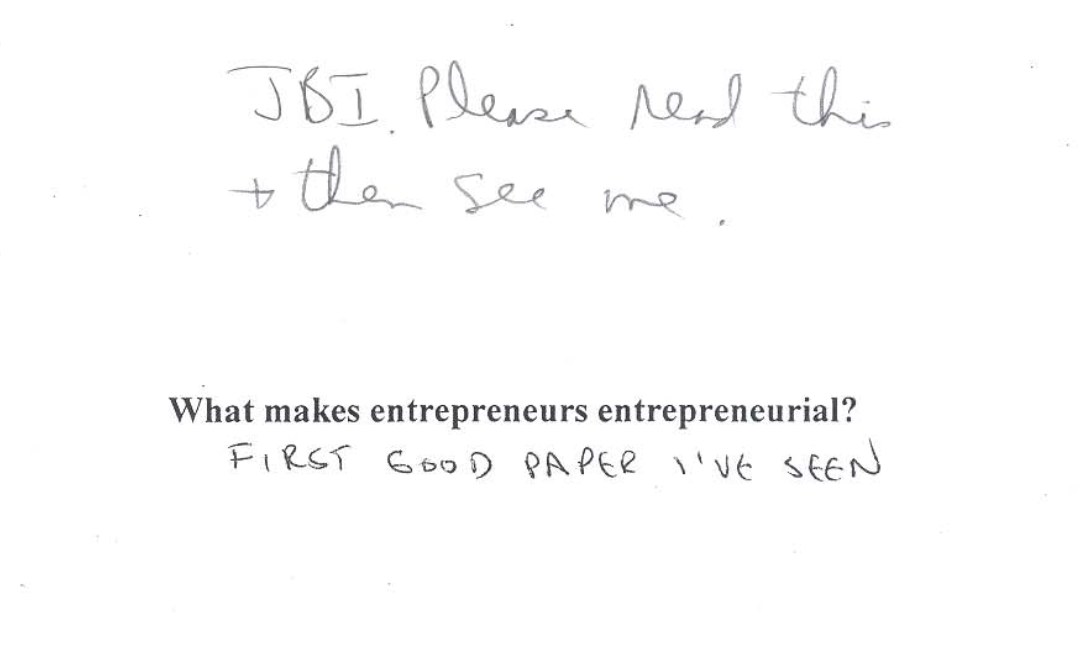
(You can read the copy with Khosla’s note here.)
Entrepreneurs think differently
The paper compares two ways of thinking. Causal thinking, which starts from a fixed goal and hunts for a way to reach it, and effectual thinking, which starts from the resources you have and imagines what you could make out of them.
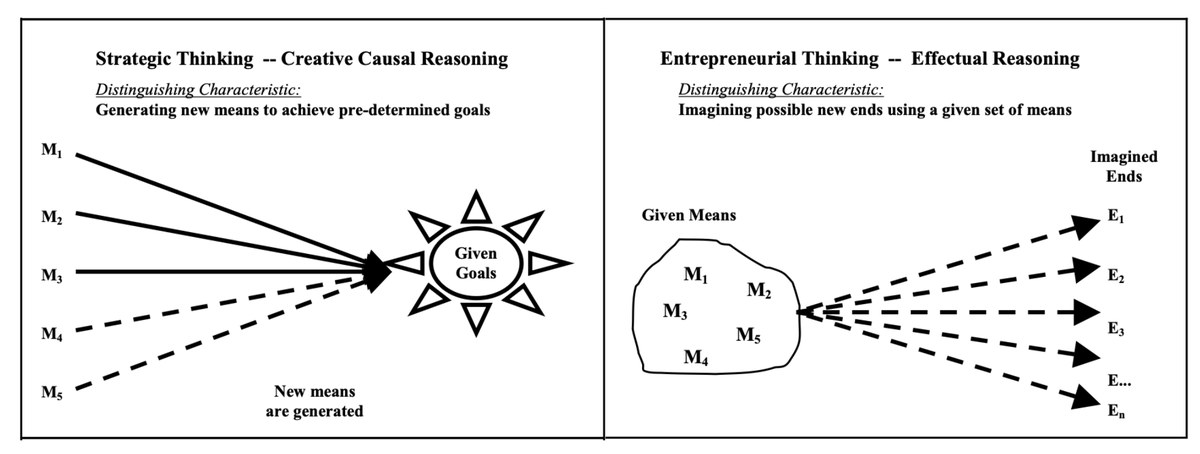
When you sit an exam or work through a task your company handed you, the goal is already set. All you have to do is find a way to hit it. That search is causal thinking. Twelve years of school, then a working life: we spend most of our lives practicing it.
But sometimes nobody has decided what to do yet. That’s the situation for a startup inventing something new. To walk a road nobody has walked, you first have to come up with the road. That’s where effectual thinking comes in. It runs bottom up: no fixed goal, and you have to find and define the problem yourself.

So where does effectual thinking start? With taking stock of what you already have. The paper says the first three questions are who I am, what I know, and who I know. In other words, look at your interests, your knowledge, and your network.
A problem, meaning a goal, that you found in that fog can change at any moment. Of course you wander when you’re exploring ground that isn’t on the map. Effectual thinking works better there, because it chases a hypothesis that keeps improving rather than one certain answer.
So creative work comes with trial and error attached. How do you keep moving forward while you’re making those mistakes?
The paper gives three principles of effectual thinking.
-
Affordable loss: start by experimenting at the lowest cost and risk you can. (Instead of expensive market research, go try selling the thing yourself.)
-
Strategic partnerships: form alliances before you analyze competitors. (Bring customers in as early partners to cut uncertainty.)
-
Leveraging contingencies: treat the unexpected as an opening instead of something to dodge.
These three keep you from collapsing under uncertainty and mistakes. You learn from them and come out stronger.
Shall we look at some examples?
Want practical tips that make you a little smarter every week?
I cover persuasion, marketing, writing, and the other skills modern life demands.
Subscribe now and get notified when a new post goes up!
Discord and PayPal
You can see effectual thinking at work in startups that made it.
Discord, the biggest gaming messenger and community in the world, started as the voice chat feature inside a game. The game failed, but users liked the chat, so the team turned it into a chat service. Today it’s used as a community management tool as well, with 400 million users. They ran trial and error they could afford, then leaned hard into a user reaction nobody planned for. That’s effectual thinking, and it produced something original.
PayPal began as a payment system between PDAs. When customers on the auction site eBay went wild for email-based payments, the company shifted to a simple payment system that plugged into eBay. It became one of the largest payment services in the world.
 Source: https://www.paypal.com/kr/home
Neither company got there by solving for a fixed answer. Both found the best business they were able to build.
Inventing a dish that doesn’t exist
Causal thinking is a chef cooking from a set recipe. Effectual thinking is a chef in an unfamiliar kitchen, making something up from whatever ingredients are on the counter. If you want to invent a new dish, the second one helps more.
The paper goes on to say the two treat the future differently. Causal thinking says you have to be able to predict the future to control it. Effectual thinking says that if you can make the future, you don’t need to predict it.
If you can make the future,
you don’t need to predict it.
Discord didn’t predict that the voice chat would land. PayPal couldn’t tell whether PDA payments were a good idea. Both accepted the uncertainty and made the future themselves.
That flip stuck with me, which is why I wanted to write about the paper.
Make it or predict it
The paper knocked me sideways. So far I’ve written a lot of posts about how to predict the future. Reading a paper that says the future is made rather than predicted, I wondered whether I’d been too passive about all of it.
Of course, making a future well takes some ability to predict too. But as I keep saying, the future is very hard to predict. You solve more problems when you can use both: causal thinking that reads the future already coming, and effectual thinking that makes whatever future you want.
There are more perspectives and approaches than these two. Each one is called a mental model. Mental models are tools in a toolbox. The more tools you have, the more problems you can fix, and using a range of thinking styles lets you handle more complicated problems. This is called the “latticework model.”
 A latticework, where every part holds up every other
I’ll cover what the latticework model is and what you get from learning it in the next post. Subscribe and get the notification!
Want practical tips that make you a little smarter every week?
I cover persuasion, marketing, writing, and the other skills modern life demands.
Subscribe now and get notified when a new post goes up!
References
-
Paper, Sarasvathy, Saras. (2008). What Makes Entrepreneurs Entrepreneurial?
-
Book, Clear Thinking
-
Picture of Vinod Khosla, By Jay Dixit - Own work, CC BY 4.0, https://commons.wikimedia.org/w/index.php?curid=146472983
You might like these too!