Why don’t we have flying cars yet?

Flying cars turn up in movies constantly, and we’ve been calling them future tech for twenty years, and there’s still no sign of one going on sale.
Is it technically impossible? No. Every so often you hear that another test flight worked.
 https://www.thedrive.co.kr/news/newsview.php?ncode=1065602981833311
So if it’s clearly possible, why hasn’t the flying car reached the market?
Because being possible doesn’t make something real. Regulation, economics, safety, infrastructure, how people see it, whether they could fly one. The practical obstacles pile up.
There are plenty of possible ideas. Listen closely to almost any startup pitch and it’s at least possible. Very few of them turn into reality. Possible doesn’t make an idea good.
So how do you tell a good idea from a bad one? What other test is there besides possible?
Possible, probable, plausible
Somebody has answered this. Aswath Damodaran, the master of valuation.
 Professor Damodaran, https://people.stern.nyu.edu/adamodar/New\_Home\_Page/home.htm
In his book ‘Narrative and Numbers’, Damodaran says a good investment idea has to be plausible and probable, not just possible.
Plausible asks whether the minimum conditions for the idea to become real are in place. Anyone can possibly travel abroad, but without a passport or a visa you’re not leaving the country. Plausibility checks for those conditions.
To prove plausibility, the strongest thing you can point at is evidence that it can happen in the real world: the technology, or a close comparable. For flying cars, the closest comparable is the air taxi.
 https://www.ytn.co.kr/\_cs/\_ln\_0102\_202403031119565432\_005.html
The air taxi due to launch commercially in Seoul in 2025 is the closest thing we have to a small aircraft. Looking at it, a car that takes off and lands vertically doesn’t seem impossible with current technology. (It’s much bigger than an ordinary car, of course.) So the flying car idea clears the minimum bar for plausibility.
Want practical tips that make you a little smarter every week?
I cover persuasion, marketing, writing, and the other skills modern life demands.
Subscribe now and get notified when a new post goes up!
But plausible doesn’t mean realistic. For something to be genuinely realistic, you have to be able to put a number on the possibility.
The last filter for realistic ideas, probable, is possibility with a number attached. Probable means the idea holds up without contradiction once you quantify it. For flying cars to go mainstream, the price has to be one a lot of people can pay. That means the car carries equipment much like a light aircraft, so the price ends up somewhere around a passenger car plus an aircraft engine and propellers.

If the flight equipment runs about 50 million won, the flying car passes 90 million won. Not many people can pay that. So before flying cars go mainstream, we’d need a breakthrough that brings down the price of wings and engines first.
To get more precise with the numbers, you could look at how fast the price of flight equipment like engines and propellers is falling, and how fast fuel efficiency is improving, then compare that against median income. Run that math and you land on the conclusion that cars won’t be flying for a good while yet.
That’s how possible, plausible and probable work.
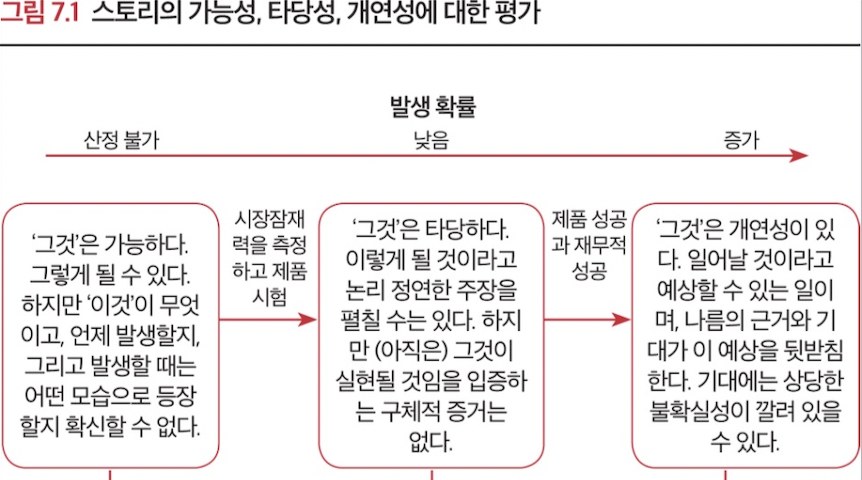 From the book Narrative and Numbers, Aswath Damodaran
Depending on your temperament, you might weight possible or probable more heavily. The earlier a startup is, the more it runs on possible, and as it grows it has to prove plausibility and probability. Same on the investing side: a VC backing early-stage startups looks at possible, while a value investor looks at probable, through the numbers
Testing one at a time
If you’ve read this far you probably have a rough grip on possible, plausible and probable. They don’t split cleanly, though. So Damodaran gives tests for ruling each one out. He calls it the continuum of skepticism, and an idea that passes all three counts as realistic enough.
 From the book Narrative and Numbers, Aswath Damodaran
- Not possible: the probability of this event is zero.
Example: we’ll build a perpetual motion machine. (scientifically impossible)
- Not plausible: the probability of the event can’t be quantified.
Example: we’ll make a drug that cures every cancer. (the probability isn’t zero, but it’s very low and hard to put a number on)
- Not probable: the probability can be quantified, but it comes out very low.
Example: we’ll bring a flying car to market. (factor in price and fuel efficiency and the odds inside ten years are very low)
Probable doesn’t guarantee that something happens. It does mean the idea is worth time and money. If you can put even rough numbers on feasibility, cost and return, you can estimate how realistic and how profitable the idea is, work out what it’s worth, and decide how much to put in. In the end it doesn’t find the right answer, it narrows the range the answer sits in.
Confidence with evidence behind it
To sum up, the lesson of the possible-plausible-probable frame is “dream while collecting evidence.” Confidence helps you succeed, but confidence past what the evidence supports (that is, with no evidence) turns into recklessness and stubbornness. The most confidence your evidence can hold up is the best posture to take. Plausibility and probability show you where the limit of that confidence sits.
None of this solves for an answer the way a math problem does. It’s a practical way to estimate an uncertain future. As I wrote in the post on the 2-4-6 rule, reasoning doesn’t remove uncertainty. It clears away a little of the fog.

For a competitive edge, clearing even a little of that fog, so you see reality slightly less vaguely than the next person, is enough. Predicting an uncertain present (and future) accurately is unrealistically hard. Predicting roughly at a reasonable cost and making a sensible bet is the most practical response there is.
Want practical tips that make you a little smarter every week?
I cover persuasion, marketing, writing, and the other skills modern life demands.
Subscribe now and get notified when a new post goes up!
P.S. I cover how to predict well in a lot of posts. Then I read a paper recently and my thinking shifted a bit. Instead of predicting the future, I decided I should do ‘this’ instead. Next week’s post will cover how my thinking changed. Subscribe and I’ll let you know.
References:
- Book: Narrative and Numbers
You might like these too!