Read the earlier posts, ‘How to talk your way into a friendship’ and ‘The motivational interviewing style that gets people to open up’, and you’ll get the full use out of this one.
The earlier posts in short:
-
To get close to someone, you have to have the conversation they want.
-
What people want is empathy and support.
-
So repeating the ‘trust conversation cycle’ of listen, ask, respond will get you close to anyone.
The ‘trust conversation cycle’ is a conversation that builds closeness and trust by repeating listen, ask, respond. The faster and deeper that cycle turns, the closer we get.
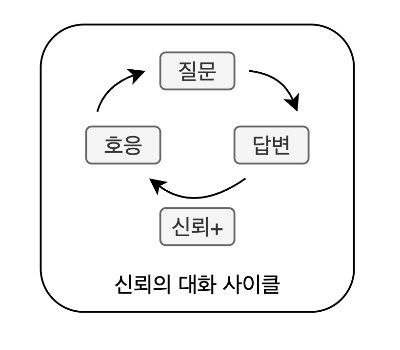
Running the trust conversation cycle takes three things done well.
-
‘Listening’ that works out what the other person wants
-
Open ‘questions’ that share feelings and vulnerability
-
‘Responding’ that empathizes and supports
So the last posts covered how to ask and how to respond.
But when it’s time to actually respond, you draw a blank, right? Which is why you need a way of responding you can use for real.
An easy and effective one is tactical empathy: “It sounds like you’re [emotion] because of [reason].”
-
It sounds like a friend betrayed you and now you can’t trust anyone.
-
Sounds like the thought of studying abroad has you pretty nervous
Use this for a while, though, and you start to notice that empathy has depth to it.
Shallow empathy vs deep empathy
We feel truly understood when someone digs out the deep (that is, the essential) feeling inside our story and responds to that, instead of taking the story at face value. Shallow empathy responds to the event and the feeling in front of it. Deep empathy responds to what that event means to the person.
For example, responding to the nervousness about studying abroad is relatively shallow empathy. Responding to the fear of leaving every relationship behind to live alone somewhere far away is relatively deep empathy.
“Going abroad must be nerve-racking” → shallow empathy
“It must have scared you, being alone somewhere unfamiliar” → deep empathy

Good conversations have a lot of deep empathy in them. But the deep feeling isn’t always easy to find. The person talking often doesn’t know why they’re telling you this either.
Still, the deep feelings people have are probably universal. So wouldn’t there be a pattern here too? As it happens, someone has found the pattern in deep feelings.
Want practical tips that make you a little smarter every week?
I cover persuasion, marketing, writing, and the other skills modern life demands.
Subscribe now and get notified when a new post goes up!
Six empathy patterns
Chase Hughes is a behavioral psychologist who says he spent twenty years in the US Navy. He also claims he can see down to the roots of a person’s character just from their behavior and how they speak.
Chase’s career and academic credibility are unclear, but the concept is useful.
In Six-Minute X-Ray, Chase Hughes’s book on ‘how to read a person in six minutes,’ what people want splits into six things. According to the book, everyone wants one of the core needs, significance, approval, or acceptance, and one of the secondary needs, intelligence, pity, or power.
The three core needs:
- Significance
-
They want to be seen as special and influential.
-
They act to draw attention by playing up achievements or how unusual they are.
-
They often bring up their own results or what makes them different, trying to stand out.
- Approval
-
They want confirmation through other people’s praise and positive words.
-
They fish for praise by expressing worry or being overly modest.
-
They’re conscious of how they’re seen and often say and do things that invite praise and approval.
- Acceptance
-
They want the feeling of belonging somewhere.
-
They express belonging through group activities and helping others.
-
They like wearing group clothing (a college jacket, a baseball team hoodie) and often talk about group activities.
The three secondary needs:
- Intelligence
-
They want people to recognize that they’re smart.
-
They often mention expertise, education, or logic.
-
They display intelligence through credentials, expertise, and difficult words.
- Pity
-
They want their misfortune acknowledged and sympathy for it.
-
They repeatedly tell stories about hardship or being wronged.
-
They repeatedly bring up a hard past or being victimized, drawing sympathy out of you.
- Power
-
They want to be seen as strong and dominant.
-
They show off strength with aggressive or threatening behavior.
-
They use gestures, clothing, and speech that look strong.
Pay attention to how someone acts, how they dress, how they talk, and you can tell what they want. Then empathy gets very easy. These six needs won’t explain 100% of everyone, but they hold up often enough to be worth using.

According to the book, people trust and like whoever says the thing that fits their need. (Close to How to Win Friends and Influence People telling you to say what the other person wants to hear.)
The friend in the example above, ‘nervous about studying abroad,’ may have been quietly bragging about getting into a top overseas university, expressing an approval/intelligence need. Or they may have been expressing an acceptance/pity need about a friend disappearing. Either way, hearing the thing they wanted to hear makes the friend feel the conversation really clicks.
That’s how you find what a person needs, what they actually want to say, and respond to that. So deep empathy comes down to memorizing six words. Significance, approval, acceptance, intelligence, pity, power.
So why does deep empathy matter?
Deep conversation, the secret to happiness and a long life
Harvard studied the conditions for happiness by following more than 200 people for 80 years. What turned out to be the most important condition for happiness?
Money? Fame? The genes you were born with?

The answer was relationships. According to the study, relationships matter most for happiness, and they reach into lifespan and physical health as well.
Dr. Waldinger, who led the study, says:
Loneliness is deadly.
It’s as dangerous as cigarettes or alcohol.
The reason I keep coming back to relationships and conversation is that our happiness and our health ride on relationships. I’d like relationships to get easier, and happiness and health to go up.

Want practical tips that make you a little smarter every week?
I cover persuasion, marketing, writing, and the other skills modern life demands.
Subscribe now and get notified when a new post goes up!
P.S. Understanding and empathizing with another person also means understanding their values. Read the earlier post that lays out people’s values in nine pieces and behavior that looked strange starts to make sense.
References
You might like these too!
- I quit my job and blogged for a year - post number 51
- How to persuade in one sentence - The One Sentence Persuasion Course summary 1
- I found the best brain science book - 1 - a review of Brain View (1)