This post covers:
a way of talking that wins someone over in 15 minutes
how to have a deep conversation with anyone and build trust
skills that draw out honesty and trust quickly in real situations
how conversation can improve your relationships and make your life happier
The conversation series is easier to follow in order.
Part 1:
Part 2:
1. Motivational interviewing changes people in 15 minutes
The last two posts used the book ‘Supercommunicators’ to explain how to talk your way into closeness. (part 1, part 2)
In summary: people want empathy and support. To give either effectively, repeat listen, ask, respond, trading feelings and trust as you go. Do that and you can get close to anyone.
I’ll call that process, repeating listen, ask, respond to build trust, the trust conversation cycle. The faster and deeper the cycle turns, the closer people get.
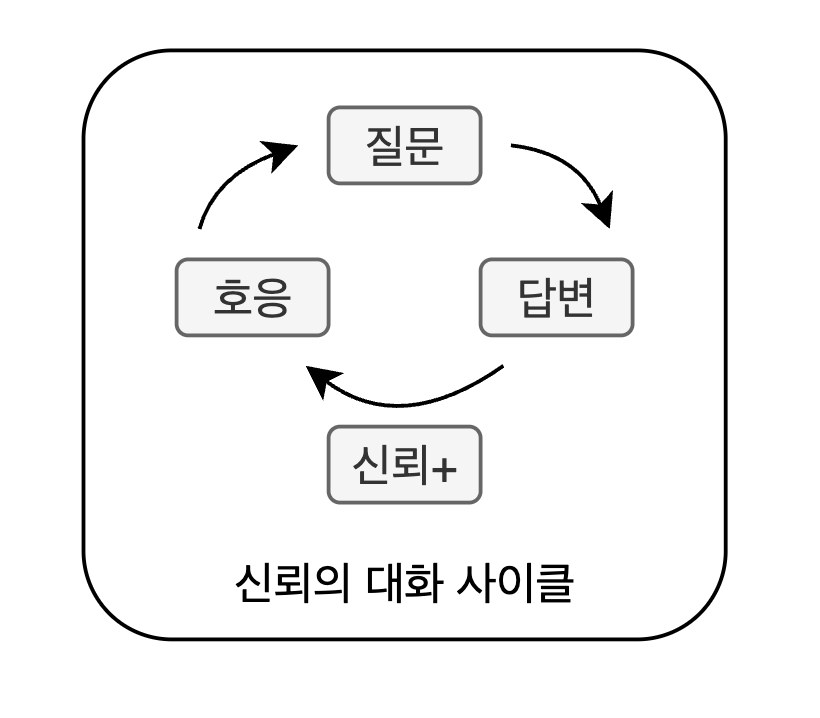
Running the trust conversation cycle takes three things done well.
‘listening’ that works out what the other person wants
open ‘questions’ that share feelings and vulnerability
‘responding’ that empathizes and supports
The trouble is that however closely you read ‘Supercommunicators’, it tells you questions and responses matter without telling you how to do either. So I’m going to hand over the formula for both, worked out systematically in a counseling approach called motivational interviewing.
 Mostly drawn from the book ‘알기 쉬운 동기면담’. Source: Kyobo
You’ve probably never heard of it. Motivational interviewing is a counseling approach strong enough that research finds it changes behavior in 15 minutes flat. It’s used across smoking, crime, weight management and more, with results to back it.
One line in the book stopped me (page 61).
Making someone feel bad is not helping them change their behavior.
That line changes how you look at a conversation, and reading it is why I decided to write about motivational interviewing.
1-1) Motivational interviewing puts the relationship first
Someone tells you about themselves and you correct them without thinking about it. Familiar? That very common correction is called the fixing reflex. It makes people shrink back and makes getting close harder. Motivational interviewing says over and over that you must not do it, and it pays attention to the relational side of a conversation that most people miss.
It’s close to Carnegie’s approach in How to Win Friends and Influence People.
Carnegie’s first principle in How to Win Friends and Influence People
Don’t criticize, condemn or complain
Even a light pass through motivational interviewing changes how you see a conversation. The center of it moves from information and right-and-wrong to empathy, support and trust.
Which is why its skills for building rapport are useful. Motivational interviewing leads a client toward change through empathy and support rather than orders, advice or questions. You build rapport, a trusting relationship, and they end up wanting to change on their own.

So motivational interviewing concentrates on building rapport through listening, asking and responding. Sounds like the ask, listen, respond method, doesn’t it?
Learn it and you can apply it to that method directly. Three skills are especially useful. The ‘open question’, which makes it easier for someone to say something deep, and ‘affirming’ and ‘complex reflection’, which respond by expressing empathy and support. Let’s work out how to use these skills, tested in thousands of clinical trials, in ordinary life.
Want practical tips that make you a little smarter every week?
I cover persuasion, marketing, writing, and the other skills modern life demands.
Subscribe now and get notified when a new post goes up!
2. The ‘open question’ that draws feelings out
As the last post covered, a good question is one that shares feelings. That means aiming for empathy questions, which ask about hopes and worries, experiences and values, rather than interrogation questions that ask for information. Try an empathy question, though, and it often doesn’t land.
That’s because a question has to be neutral and open before someone will speak honestly about themselves. Motivational interviewing’s ‘open question’ is a good way to build one. An open question pulls a long, honest answer instead of a yes/no or a single word. Things like ‘how was ~~?’ or ‘tell me about ~~’.
 An open question draws an honest, self-expressive answer.
Open questions lead to honest answers. And as I said, trust builds when you respond to an honest answer with support and empathy. So let’s look at the skills for responding that way.
3. ‘Complex reflection’, responding with empathy
As the last post said, responding is what completes a conversation, and responding is empathy and support. Empathy is ‘so that’s how you felt’, support is ‘I think it makes sense that you would’. A tidy summary, but it doesn’t tell you how to actually do it. Motivational interviewing’s complex reflection is an effective way to empathize.
Empathy splits into two steps.
- work out what they’re feeling
- let them know you worked it out
Knowing what they feel isn’t enough on its own. Think ‘he must be sad’ privately and they’ll never know. You have to express that you know. That’s what makes them feel understood.
So how do you empathize well? Motivational interviewing says reflection is the best method there is.
Reflection means playing back what the other person said. Done that way, it gives them the feeling of being understood.
How you play it back is what separates the kinds of reflection.
Repeating: say their words back exactly
Rephrasing: change the wording slightly
Putting it differently: guess at the meaning they didn’t state, and say that
All three work, but compared with simple reflection, which repeats their words back as they were, complex reflection, which guesses at the meaning they didn’t state, is a far more effective response. Guessing adds something new, so the conversation doesn’t get boring, and you get to empathize with what they haven’t said yet. A guess that misses is fine. They’ll correct it, and correcting it means saying more.

There’s also a technique of reflecting back overstated or understated.
Them: work was rough today.
Response: sounds like something enormous happened at work. (overstated)
Response: sounds like you got a little tired today. (understated)
Their own fixing reflex kicks in to correct the overstated guess, and they say more.
Complex reflections that acknowledge a conflict they’re stuck in, or dig out a feeling, draw out deeper talk as well.
Them: I’ve got no drive for anything lately.
Response: you want to live hard at it, and you also feel like you don’t have the strength (acknowledging the conflict)
Response: it sounds like you feel stuck with nowhere to go (digging out the feeling)
Reflection is deep empathy. It shows the other person that you understood them.
4. Affirming, responding with support
The other way of responding, ‘affirming’, supports someone through praise. It works better when you praise their effort and their achievement specifically. Look at their decisions and actions in a positive light and there’s always something you can affirm.
Them: I got up late today and did the housework.
Affirmation: you were tired and you cleaned the room instead of resting.
Sometimes there’s nothing obvious to praise. You might not know the person, or there might genuinely be nothing. Then you can affirm the meeting itself. ‘Glad you could come’, ‘good to see you here’. Or after they’ve said something, ‘that was a detailed explanation’, or ‘oh, that’s fascinating’.

Even small praise gets awkward if it doesn’t feel sincere. Making yourself the subject carries the sincerity better. Instead of ‘your persistence is incredible!’, try ‘I was surprised by how persistent you are’.
Either way, what matters is doing it naturally and meaning it.
5. Tactical empathy
To use all of this faster, ‘tactical empathy’ does the empathizing and the asking in one move. It comes from ‘Never Split the Difference’, by the FBI hostage negotiator Chris Voss. One sentence of empathy settles the other person’s emotions, opens them up and keeps the conversation going.
Tactical empathy
Is it fair to say you’re feeling [emotion] because of [reason]?
See every skill so far folded into one line? It shows you care how they feel and that you understand why they feel it. It affirms the feeling, and it asks whether you got it right.
Motivational interviewing, though, doesn’t ask a question while responding, because a question can add pressure. So we could adjust it.
Comfortable tactical empathy
It sounds like you’re [emotion] because of [reason]
-
It sounds like a friend betrayed you and now you can’t trust anyone.
-
It sounds like the thought of studying abroad has you pretty nervous.
Put that way, you get a reflection and an open question at the same time.
6. Judging your own responses
You’ll want to know whether your responses are landing. Don’t put much weight on a plain ‘yeah, that’s right’, since they might just be being polite. Watch instead for the stronger signs of agreement.

For example:
they repeat your response back
they add to your response (like ‘right, and also ~’)
they react emotionally to your response and agree with it
Reactions like these tell you the empathy landed.
When you’ve read them right, they respond to what you said or actively confirm it.
7. Communication skill is a condition for a happy life
Harvard’s ‘Grant Study’ followed 2,000 lives for 70 years to find the conditions for happiness. The core factor in a healthy, happy life was ‘satisfaction with your relationships’. So the communication skills in this post are a way of getting happier.

The summary: people get close when they share feelings and vulnerability. To do that, use open questions to share hopes and worries, experiences and values, going deeper as you go. Then empathize and support with complex reflection and tactical empathy. And don’t criticize, condemn or complain. Last, all of it has to happen naturally, and sincerely.
This post is also a record of me working out my own problem. I’m not a particularly attentive person. Maybe because of that, people used to tell me I wasn’t empathetic. In a conversation I’d lock onto the information and miss the meaning and the feeling.
Conversations often skated along the surface and felt empty. I kept wondering what the problem was. It took me a long time to learn that a conversation is the process of understanding each other and ending up on the same side. Everything above is what I was chewing on.
I’ve met plenty of people who struggle with relationships the way I did. The difference in all of them was one thing: they just didn’t know how relationships and conversations work. When I explained this material to them, they built deep relationships soon after, and I watched them get happier.
Organizations are the same. Winning people over with words costs nothing. Even so, I’ve seen a lot of teams and companies fall apart over poor communication. That problem is solvable too.
That’s why I decided to write this.
To make it usable for as many people as possible, I built it on cited research and sources so it would be solid and practical. The result is the nonviolent communication two-parter, and the conversation trilogy you’re reading.
Good luck to everyone wrestling with people problems.
P.S. If those last paragraphs gave you a sense of who I am and why I write, I’m glad.
And if you also noticed that I just shared experience, vulnerability and goodwill, I’d be downright pleased with myself.
Want practical tips that make you a little smarter every week?
I cover persuasion, marketing, writing, and the other skills modern life demands.
Subscribe now and get notified when a new post goes up!
Books referenced
-
Supercommunicators (link)
-
알기 쉬운 동기면담 (explains it clearly. Recommended)
-
Motivational Interviewing, 4th edition (if the book above left you wanting more)
-
Never Split the Difference (an excellent book on negotiation, recommended)
-
Getting More (an excellent book on negotiation and conversation, recommended)
You might like these too!