There’s a miraculous spring in the French town of Lourdes.
Legend says that if you step into it, your illness is cured. Some people apparently did get better. Which is why five million people from all over the world still visit every year.

When Richard Feynman, the brilliant American scientist, heard about the legend, he had a question of his own.
If the legend is true, shouldn’t we be studying it so more people can use it?
If you really believe in a healing miracle,
you have a responsibility to investigate it closely and put it to better use.
Obvious enough once you say it out loud. Five million people go to that spring every year, so why does nobody think this way?
Because they saw the words ‘miraculous healing powers’ and stopped thinking.
The point where thinking stops
Solving a problem means going over it again and again until you find the answer. Sometimes that doesn’t happen.
Just like the way people’s critical thinking shut down in front of the name ‘miracle spring’.
Mystery isn’t the only thing that stops people. Authority does it too. The psychologist Milgram’s experiment is the standard example: people delivered a lethal 450 volt shock to a stranger for no reason other than that the researchers told them to.
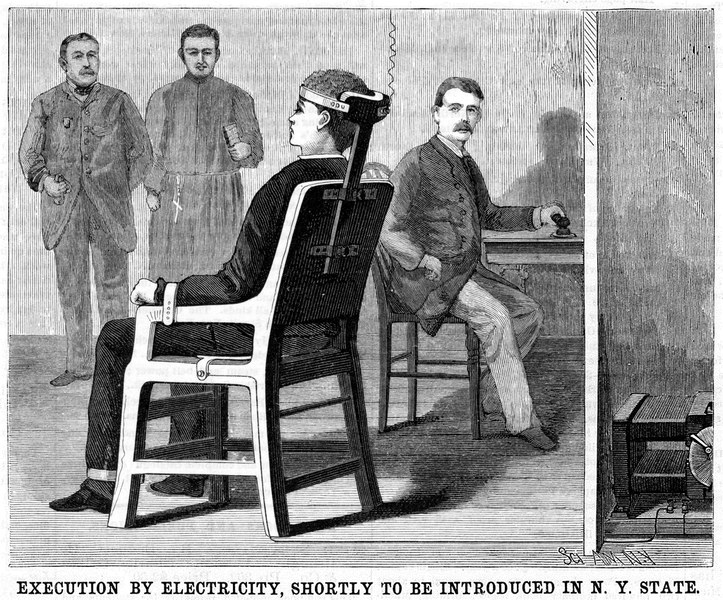 Scientific American, Volumes 58-59, Munn & Company, 1888, page 407
They heard the order to deliver the shock and followed it without thinking about the result, which was death.
So our thinking stops in all sorts of situations: bad assumptions, vague belief, going along with the group, obeying authority, fear and fantasy. Let’s call the things that cut our thinking off ‘thought breakers’, after the circuit breaker that cuts the power.
The world is complicated, so we get things wrong sometimes, and we have to work out what we’ll do when we’re wrong. A tripped thought breaker blocks that work. It covers our eyes and hides the fact that there’s any danger at all.
It gets ugly when your thinking stops in the middle of an important question. You can lose everything you own.
Want practical tips that make you a little smarter every week?
I cover persuasion, marketing, writing, and the other skills modern life demands.
Subscribe now and get notified when a new post goes up!
Here’s a good example. Albatross (Seong Pil-gyu), a legend of systematic trading and the author of ‘How to Beat Money’, wrote this on his blog.
6. What I ask, and keep wanting to ask, is this..
What on earth are you going to do when your thinking is wrong?
If you can’t answer that.. there’s no point in you staying in this market.
Take the money you have left and go travel with your family, is how I see it.
” The person who recommended it told me to keep holding. “
That’s the stupidest sentence I’ve heard in this market, and I’ve heard it to death.
Why do so many people say something that stupid, over and over? Blind faith in the ‘person’ who recommended it, and the thinking that gets cut off because of it. People tend not to think in the direction they don’t want to go, and the result can be fatal. All the more so if you’re doing something as complicated and risky as Seong’s derivatives trading.
So what do you do about a tripped thought breaker?
Flipping the breaker back up
Sadly, the shutdown is instinct. You can’t stop it from happening.
What you can do is notice that you’re in the shut-down state and pick the thinking back up. That takes looking at your own thoughts from the outside. Do I have grounds for the conclusion I reached, why do I trust those grounds, and what are the ways this could be wrong.
The same goes for the guy above holding a stock on nothing but someone else’s tip. If he’d been aware that his only reason for buying was a tip, that he didn’t know why he trusted it, and that it might be wrong, he wouldn’t have made a decision that dangerous and that helpless.
The best way to look at your own thinking objectively is to get help from someone else. According to Superforecasting, a book on how to reason well, groups whose members caught each other’s tripped breakers predicted the future more accurately than experts did. (I’m covering that book soon, so subscribe and I’ll let you know!)
If nobody’s around to help, writing your thinking down works too. As I went through in the last post, it’s a very good way to watch your own thoughts from the outside. Writing lets you catch the shutdown and keep working the question. Psychology of Intelligence Analysis, a book the CIA used as training material, gives the same advice: think by writing.
The Feynman technique makes it easy to watch your own thinking and fix the errors.
If you’re curious how writing lets you think, read the post on the Feynman technique!
Want practical tips that make you a little smarter every week?
I cover persuasion, marketing, writing, and the other skills modern life demands.
Subscribe now and get notified when a new post goes up!
P.S. My own writing shouldn’t become a thought breaker either. That’s why I put the source links on every post. I’d like you to doubt what I write, argue with it, take it apart. Feel free to put the results in the comments. I’d rather my posts be a transfer station than the last stop.
References: Clear Thinking, Superforecasting, Psychology of Intelligence Analysis
You might like these too!