Did you write something that reads well?
Do people read your writing and tell you it’s really well written?
Then you have a problem.
Because that’s only half a piece of writing.
The last post looked at why people move. What moves us is emotion, not reason. Balance, stimulation, and dominance in particular.
I found the best brain science book - 1 - a review of Brain View (1)
So how do you use writing to move someone? Let’s take apart 끌리는 문장은 따로 있다, the book that holds the answer.
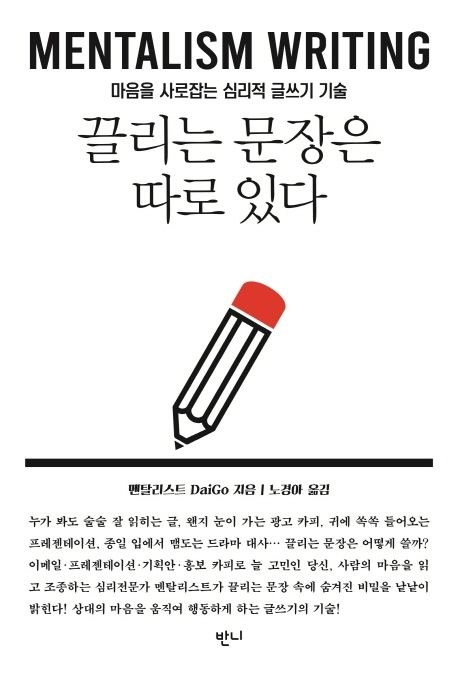
Tip: the front of a book is where the core is.
As I explained in an earlier review, the front of a book is the core.
A nonfiction book splits into two parts, the argument and the tips. The argument usually comes first, and the practical methods come after.
The argument at the front is the author’s own claim about how the world works. Call it a frame, a question, a premise, or an axiom.
Brain View, the book I covered last time, argues at the front that emotion runs people.
The back gives you the practice that follows from that claim. Emotion runs people, so here are the marketing techniques that use it.
Most people focus on the tips in the back. They hand you things to do, so it feels like learning.
But the core of a book is the argument at the front.
If you don’t understand the argument properly, you can’t use the tips properly either.
Once you understand what the author assumed, you understand why the tips work.
Following steps without understanding the principle is what we call shallow knowledge.
Shallow knowledge and deep knowledge are covered in another post, through the scientist and his driver (link)
Want practical tips that make you a little smarter every week?
I cover persuasion, marketing, writing, and the other skills modern life demands.
Subscribe now and get notified when a new post goes up!
Back to the point,
what does this book argue?
You write to make people move
Let me clear up one misunderstanding first.
Why do we write? What is writing for?
Do we write so a reader will read it?
No. What’s the point if they only read it?
To pass on information, then? Half right, but that isn’t the end goal.
As an earlier post covered, we write to make people act.
Good writing always has a purpose - 1 - good writing changes the reader
That’s this book’s argument too.
When you write, you have to know what you want the reader to do. Decide the effect you want before you write.
How does writing make a reader act?
The secret is imagination.
The strongest force in the world
Writing sets off imagination.
 Einstein: imagination will take you everywhere.
When people hear imagination, they think of some grand power, like daydreaming up whole worlds.
It isn’t. Imagination is a simple thing we do all the time.
Here’s an example.
“A red balloon”
When you read those words, did a red balloon come to mind?
That’s imagination.

Here’s a more entertaining one.
“You’re sewing with a silver needle. Ouch! The needle goes into your thumbnail. The nail turns red with blood.”
How was that? Did your skin crawl? If you flinched at the idea of a sharp needle going under a nail, that was imagination too.
I can’t actually push a needle into your nail. But a few sentences can bring up something close to the same pain.
That’s what writing does. It makes the reader imagine.
Imagination is experience
One last story, about a friend of mine.
He bought a cheap wooden bookshelf on Temu. The wood couldn’t have been finished properly, because while he was cleaning the shelf a splinter went into his nail.
The splinter was under a centimeter, stuck beneath his index fingernail, too short to pull out with his fingers. Poking at it only drove it deeper.
At the clinic they eased it out with tweezers and blood dripped from the nail. All because of cheap wooden furniture.

How does that sit with you? From now on, when you see a cheap wooden bookshelf, this story will come back.
Because you imagined it as you read, which means you experienced it secondhand.
A story creates experience, and it changes the reader.
A short story is enough to change behavior. You probably don’t want to touch a cheap wooden bookshelf now.
All of it comes from imagination. So before you write, decide what you want the reader to imagine.
The book says there’s a mistake we make often at this point.
Thinking from our own point of view.
Don’t write for yourself
Most people assume everyone else imagines what they imagine.
What I like, other people like. What I hate, other people hate.
Reality isn’t that easy.
If we write hard, will the reader read closely? No.
Even when the government offers a tax refund, most people ignore it.
 https://www.yna.co.kr/view/AKR20231011159500001
So how do you catch the attention of people who don’t care?
You have to know their interests, desires, and fears.
(An earlier post covered which desires come with which personality type!)
The limbic system: three ways to make money - a review of the brain science book Brain View (3)
The book puts it this way: the material for your writing sits inside the other person’s mind.
So how do you look inside someone else’s mind?
The book gives seven methods. I’ve reorganized them into three so they read more easily.
Desire, relationship, and difference. The next post takes them one at a time.
Subscribe now and get notified when next week’s post goes up!