Last time I read a behavioral economics paper, ‘Behavioral problems of adhering to a decision policy’. I’d read that one first.
The short version: people don’t act the way they resolved to, and small things push their decisions around.
To find a way around that, I read a stack of books on decision making. The main ones were “More Than You Know”, “Think Twice” and “Clear Thinking”, plus a lot of posts on lesswrong.com and fs.blog.
Putting what I learned together gave me a three step way of setting rules that props up your decision making. Here it is in detail.
1. Settle the plan before you act
As we saw, the instinct is to change the strategy. Set it in advance, though, and you stop yourself from rewriting it mid-run or quietly ignoring it. Build the strategy before you act, then stick to it while you act. Decide clearly which rules you’ll follow, and follow them exactly even when your nerve goes in the moment. A rule you follow only when you feel like it isn’t a rule.
A strategy can’t cover every situation, though. The world is more complicated than you planned for. You need a way to judge the cases you never thought of.
 How do you use a rule in an emergency it doesn’t cover?
So what do you do? Instead of a flat rule, use the intent behind it, and it stretches across many situations. That’s why step two is setting the intent.
2. Settle the strategy’s intent
US military operation plans carry a short line called “commander’s intent”. It’s the commander’s goal, stated briefly.
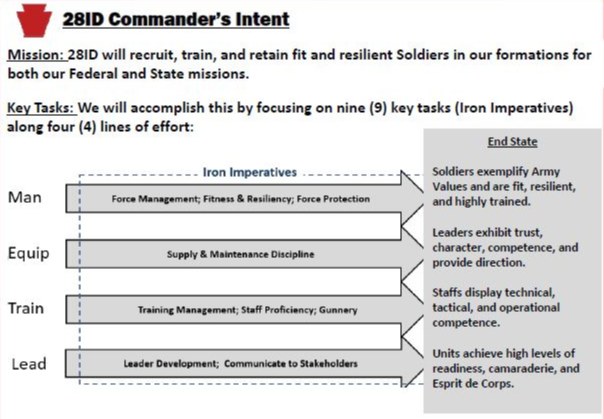 Commander’s intent from the US National Guard. Source: www.pa.ng.mil/
With the intent written down, the people under him can bend with a changing situation and still serve the overall goal. It’s the shape a rule needs when things get complicated.
Say the operation plan is “take city A”. The commander’s intent could be written like this.
Commander’s intent: take city A
Default approach: break through the defensive line head on
Now, if the enemy line is too solid to break, the unit can still take city A by going around it. Without the stated intent, that call is hard to make on the ground.
Statutes do the same thing, spelling out the purpose of the law.
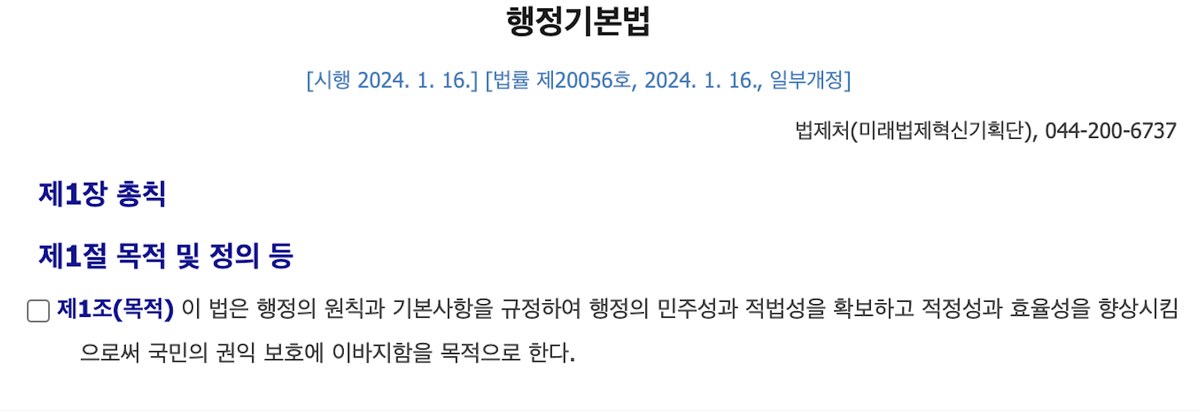 Source: https://www.law.go.kr/lsInfoP.do?lsId=014041&ancYnChk=0#0000
The world is very complicated. To be ready for what you didn’t expect, a broad guideline beats a finely detailed rule. ‘No Rules Rules’, the book about Netflix’s company culture, makes the same case well.
Once the intent is fixed, a complicated situation doesn’t sweep you off the plan. The harder you think about whether that intent is the right one, the sturdier the strategy gets.
Sometimes, though, you shouldn’t follow the strategy at all. There are exceptions where the benefit disappears and the side effects start. There will always be cases you didn’t account for when you drew the strategy up, so you can’t get rid of exceptions. What you can do is tell when you’re in one.
Want practical tips that make you a little smarter every week?
I cover persuasion, marketing, writing, and the other skills modern life demands.
Subscribe now and get notified when a new post goes up!
In the moment, though, judging objectively is hard. Watch a chart do something strange and it feels like this, right now, is the exception. That’s why selling at your stop price is so hard. Relationships work the same way. You can have a rule that says “two lies and I’m out” and still think “this one seems different”, or “this one will change”.

But knowing when to drop a rule is its own fog. I’ll keep saying it: our judgment is easy to push around. So dropping a rule needs a rule of its own, and that rule is the strategy’s assumptions and exceptions.
3. Spell out the strategy’s assumptions and exceptions
No strategy is perfect. Every one of them rests on some assumption about how things are, so when that assumption breaks you have to drop the strategy without flinching. The trouble is that we don’t clearly know which cases are the exceptions. We end up judging on the spot whether this is one, and of course we get it wrong. “This chart is different.” “This person feels different.” When the only thing that actually changed was the standard we were judging by.
So when you build a strategy, write down its assumptions and its exceptions. An assumption is the reason the strategy works at all. Every strategy has the shape “(because the world is like this) if I act like that, I can expect this result”. For the strategy to work, our guess about how the world is, the assumption underneath it, has to be right. Take the strategy “live decently and good things come to you”. For that to work, the assumption “decent people get good things” has to hold. (Doesn’t look like a safe assumption to me.) But we forget what we assumed, all the time. Or we’re certain our assumptions always hold. The two are close relatives and both are dangerous. In 2008, “US house prices always go up” was taken as a given.
 Source: https://www.businessinsider.com, Photo by Oli Scarff/Getty Images
Plenty of people lost their houses and their jobs over it. Danger sits and waits exactly there, in the weak point of a strategy (its assumptions) that we haven’t noticed. I think it’s close to what Nassim Taleb calls a “black swan”.
You can only spot the danger if you know which assumptions you’re standing on.
Exceptions, like assumptions, show you where a strategy stops working. You need the assumption “someone who lied twice will lie again” before you can set the rule “two lies and I’m out”. There are also exceptions where that assumption doesn’t hold. Maybe they meant it as a kind lie. In that case you might read them as an honest person. Something they said that turned out false because they were misinformed counts as an exception too. Judging cases like these clearly means working out the strategy’s limits before the exception shows up. And a strategy’s limits are what its assumptions and exceptions describe.
Understanding your own strategy’s assumptions clearly is what lets you decide how long to keep following it. That’s what makes it possible to drop the strategy when it starts working against you. Momentum makes you worse at that call, which is why it needs the extra attention.
 You never know when or where a black swan turns up.
Companies burn plenty of time on work that stopped being necessary. At a company I used to work for, a marketing team was putting together the preorder campaign for a product launching in two weeks. The campaign needed to start as soon as possible. Instead the team kept revising the plan and spent all two weeks preparing it. The product launched, and preorders were no longer possible. The time and effort went nowhere, and the campaign never ran. These weren’t shallow or lazy people. They just worked the way they always worked, in a situation that wasn’t the usual one. The time pressure may have narrowed their view further.
 A lot of time gets poured into work like this, which is worth nothing.
“Improve the campaign plan” is a useful strategy most of the time. It rests on the assumption that a more polished plan produces a better result, and that assumption has exceptions. A hard deadline, like the one above, is one of them. Had they asked what the strategy assumed at the start, I think the waste was avoidable.
Thinking about the premises (the assumptions) under your own opinions patches a hole in human judgment. Here’s the psychologist Philip Johnson-Laird, who studied mental models. (Mental models are coming up in the knowledge series soon.) As he sees it, people reason from a set of premises, so they only consider what fits the premises they already hold. The result: people never consider the things they believe are false, not even at the start. (quoted from Michael J. Mauboussin’s ‘Think Twice’) We ignore the chance that we’re wrong. Which is the part that matters most.
Piling up reasons why you’re right doesn’t make your decision more accurate. Digging into how you might be wrong, so you know when to drop the strategy, is what cuts down your bad decisions. Charlie Munger has said he only lets himself hold an opinion once he knows the case against it as well as the people who hold it.
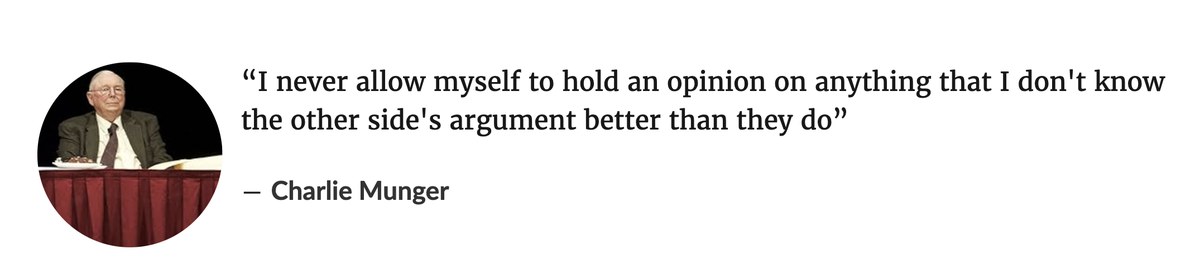 https://www.goodreads.com/quotes/7447184-i-never-allow-myself-to-hold-an-opinion-on-anything
Not knowing a rule’s limits means following it blindly, and the side effects come with it. Once you understand both what your rule is good for and where it stops, you can use it freely.
People waver. Rules hold.
The paper in one line: we are wavering creatures. Build a sturdy rule and use it, and you can stay steady and still bend where you need to. So lean on rules. Nothing in the world is perfect, but a rule you thought hard about is about as trustworthy as it gets.
 I’m hoping a rule can be the lighthouse that shows you a direction inside the storm.
I’ll close with a line from David Sklansky, the world class professional gambler who stressed how much strategy matters. (quoted from the book ‘More Than You Know’)
If you bet on the most favorable side after careful calculation,
you have already made money, whether you actually win or lose.
In the same way, if you bet on the unfavorable side without calculating properly,
you have already lost money, whether you actually win or lose.
Since you can’t lean on your gut, winning on the plan before the fight starts isn’t optional.
Why you shouldn’t follow your gut carelessly - second order thinking
P.S. Even with second order thinking, a plan can’t be perfect, and something you didn’t expect eventually happens. How do you prepare for that? Nassim Taleb explains it best, I think. Let’s work through it with his Incerto quartet.
Want practical tips that make you a little smarter every week?
I cover persuasion, marketing, writing, and the other skills modern life demands.
Subscribe now and get notified when a new post goes up!
References:
-
Slovic, P. (1973). Behavioral problems of adhering to a decision policy.
-
More Than You Know, Michael Mauboussin
-
Think Twice, Michael Mauboussin
You might like these too!
How to persuade in one sentence - The One Sentence Persuasion Course summary 1
I found the best brain science book - 1 - a review of Brain View (1)
What if you read ten times faster? - reading series 1: how to read a book well