This is a breakdown of the book ‘Supercommunicators’. It covers:
- how to get close to a stranger fast
- how to get close to someone through questions
- how to respond so they open up
This follows on from the last post. Read that one first.
Last time we covered the core skills of conversation.
1. Say the thing the other person wants to hear.
2. Listen, ask and respond until you find what that is.
And the three skills that make it work.
-
Listening that works out what the other person wants
-
Questions that share feelings and vulnerability
-
Responding that empathizes and supports
The last post covered listening, so today is asking and responding.
4. The skills of communication
2) Questions - sharing feelings and values
In the study mentioned above, the ‘Fast Friends Procedure’, people did nothing but ask each other questions for an hour. Nothing but questions, and 60% contacted each other afterward, and some of them got married. Questions are powerful.
Not every question builds closeness like that, though. The questions used in that experiment were the special part. Let’s call that kind an empathy question, and call the kind that builds no closeness at all an interrogation question.
Two kinds of question, then.
Interrogation question: digging for information
Empathy question: sharing feelings
You see interrogation questions in crime films. A closed room, an investigator pouring questions at a suspect. In the film ‘Decision to Leave’, the detective Jang Hae-jun (played by Park Hae-il) pours dry questions at Song Seo-rae.
Name? Age? Where do you live? What do you do? What did you do yesterday? And on and on.
 Source: the film ‘Decision to Leave’
Questions like that pull a lot of information out efficiently. An hour of them and you could write the person’s resume for them. But does the investigator end up close to the suspect? No. Interrogation questions give you information and build no relationship. They only draw short, disconnected answers, so the conversation is hard to keep going. What you get is a stop-start string of question and answer.
The opposite is the empathy question, which asks about feelings. Instead of a one-word answer, it gets people explaining their own story and values. That’s why empathy questions get people close. In ‘Decision to Leave’, Park Hae-il develops feelings as he listens to Tang Wei’s story. Crime dramas all work this way. Once we’ve heard the criminal’s sad backstory, we start rooting for him. Emotional alignment, which is to say empathy, comes from a story and not from information. Why? Because emotional questions set off ‘emotional contagion’.
What is emotional contagion, and why does it get people close?
2-1) Emotional contagion: the secret inside a question that builds closeness
Humans are social animals, so we have an instinct to feel close to anyone feeling what we feel. Emotional contagion is catching the feelings of the people around you, feeling for yourself whatever they’re expressing. Because we’re social animals, it runs deep. The book says even newborns copy their mother’s expression. That’s one thing worth learning from a newborn.

To get close to someone, respond to their feelings and express the same feeling back. Share the memories where you cried, laughed and gave up, and you catch each other’s feelings. That’s how it happens.
Beliefs, values, important memories and secrets do the same thing when they’re shared. People who communicate well asked questions that share feelings, desires and values. People who don’t asked interrogation questions with one-word answers.
So which feeling spreads best? At a glance, happy memories look most positive and most useful. Angry memories seem to pull people together too. The answer sits somewhere else.
2-2) Vulnerability: the feeling that makes friends
The research says people feel closest when they’ve shared a vulnerable feeling. Vulnerability here means the weak, unsteady stuff, your flaws and your anxiety.

One study found that a lawyer who stumbles over a word or drops something is better liked than a lawyer with a flawless image. So sharing your strengths alongside small secrets and small weaknesses, a bit at a time, is a safe way to build goodwill. It also keeps the other person from using a weakness of yours against you.
Successful teams need vulnerability and trust too. Google’s 2012 study found that successful teams score high on ‘psychological safety’ and ‘trust’. Psychological safety means a state where team members can share vulnerability without worrying about it. Vulnerability and trust don’t just make people friends, they make people good teammates.
Closeness builds when you trust each other enough to show the parts that could be criticized, and then support each other for it. It looks a lot like a trust fall. In a trust fall two people stand one behind the other, and the one in front shuts their eyes and drops backward for the other to catch.
 Source: the official Hearthstone site
The person behind might not catch you. It’s frightening, and you have to trust them anyway. When they answer that trust by catching you, a relationship exists.
Want practical tips that make you a little smarter every week?
I cover persuasion, marketing, writing, and the other skills modern life demands.
Subscribe now and get notified when a new post goes up!
So how do you build a question that shares feelings and vulnerability? Three ways.
-
Ask about feelings, experiences, desires and worries.
-
Ask why they answered that way.
-
Start light and take turns.
One at a time.
2-3) How to build a question that gets you close:
A conversation that works handles feelings, values and goals. A question that gets you close just has to ask about those. Throwing one out is easier than you’d think.
(1) Ask about feelings, experiences, desires and worries.
As an earlier post explained, feeling is what moves people.
I found the best brain science book - 1 - a review of Brain View (1)
Poke at feeling and a conversation turns dynamic in the same way. Talk about feelings and the information and the values come out on their own. Experiences, desires and worries do much the same. Instead of a short-answer question about information, ask what they feel, what matters to them, what they want.
Experience: how has working out in the mornings been?
Desire: what do you want to do on your holiday?
Worry: is there anything at work you’re worried about?
(2) Ask why they answered that way.
The music someone likes matters less than why they like it. The reason shows you what’s deeper in them. To hear more of the story, ask for the reason. Some people get defensive at the word “why”, so it’s fine to soften how you put it.
What do you do for work? => When is work most enjoyable for you? What’s the enjoyable part?
Anywhere you want to travel? => Why there? Which trip do you still remember?
(3) Start light and take turns.
Deep subjects build the closeness, but starting with light questions keeps the pressure off both sides. Start on everyday ground, the weather, hobbies, something that happened, then ask for reasons as in point 2, and the questions get deeper as you go.

Also, closeness doesn’t appear when only one person is asking. Trust has to build in both directions. After a deep question, share something deep of your own.
Why you can’t become friends with a chatbot… “AI has no story of its own” - AI Times
The critic Shin Hyoung-cheol wrote this in ‘정확한 사랑의 실험’.
We believe that ‘other people are simply bad,
and that I am complicatedly good’.
Can someone else fully understand complicated us? Probably not. And we don’t understand other people easily either. We really are different from each other. Which is exactly why you have to ask. What they’ve been through, what they want and worry about, what matters to them, and you have to draw out answers with something honest in them.
And when you respond to those answers honestly, trust and closeness appear.
Which leaves the last piece of the puzzle, responding. The core of it is affirming and supporting the other person.
3) Responding - empathy and support
As I said before in ‘How to persuade in two words’, affirmation opens people up.
How to persuade in two words - The One Sentence Persuasion Course summary 2
Affirmation means not criticizing the other person. It’s the core of responding.
A conversation runs listen, ask, respond. All three matter. A conversation without responding is a monologue, and all it leaves behind is frustration.
Responding well is what completes the cycle and deepens the relationship. Answer a deep question honestly and get a distracted ‘sure, whatever~’ back, and it feels like a betrayal. Get ‘no, you’re wrong about that’ and the door closes.
Of the three purposes of conversation from last time, information, support and empathy, the conversation that builds closeness runs on support and empathy.
 Empathy: ‘so that’s how you felt’ & support: ‘I think it makes sense to feel that way’
That’s the job responding does: genuinely empathizing with and supporting what the other person told you. Empathy is ‘so that’s how you felt’, and support is ‘I think it makes sense to feel that way’.
Some people do the opposite. Saying something unrelated to what they said (no empathy), or criticizing what they felt (no support), is common. That kind of conversation doesn’t get you close.
Carnegie’s first principle in How to Win Friends and Influence People
Don’t criticize, condemn or complain
As Carnegie put it, a conversation short on empathy and support leaves nothing but hostility.
However well you listen and however good your questions, the relationship deepens only if you respond well to the answers. Bobbing your head isn’t responding. Responding needs support and empathy in it. The best response of all is complex reflection, from motivational interviewing, and that’s the next post.
5. In conclusion: empathize and support
Getting close takes empathy and support. Doing either effectively takes repeating listen, ask, respond. I’ll call that process the trust conversation cycle.
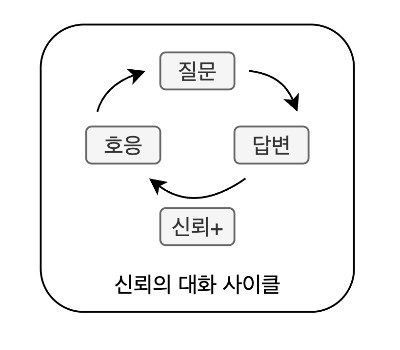
Build trust and closeness with the ask, listen, respond cycle and you can get close to anyone. Blackpink’s song ‘As If It’s Your Last’ says the same thing.
 Source: https://youtu.be/RxCoth-\_tHs
When I throw myself to you, hold on to me tight
because the world won’t be able to break us
One line of lyrics holds what a relationship actually is. We try trusting each other with a question, and pay that trust back with a response. Take turns trusting and responding, and we get close.
P.S. Questions and responses are the core of conversation. Want to get better at both?
For an easy way in, an earlier post of mine, ‘How to persuade in one sentence’, covered how to support and encourage someone.
How to persuade in one sentence - The One Sentence Persuasion Course summary 1
There’s actually a formula for asking and responding, worked out systematically in a counseling approach called motivational interviewing.
Motivational interviewing changes people through questions and responses, and it’s been applied to smoking, crime, weight management and plenty else to shift behavior. It’s strong enough that there’s research finding 15 minutes of it is enough to work.
Two pieces of it are very strong: a way of asking called the open question, and a way of responding called complex reflection.
Next post: the motivational interviewing skills that make a friend in 15 minutes.
Want practical tips that make you a little smarter every week?
I cover persuasion, marketing, writing, and the other skills modern life demands.
Subscribe now and get notified when a new post goes up!
References
-
Book: Supercommunicators (link)
-
Book: How to Win Friends and Influence People, by Dale Carnegie
-
Book: 알기 쉬운 동기면담 (explains it clearly. Recommended)
-
Book: Never Split the Difference (recommended)
-
https://positivepsychology.com/motivational-interviewing-effectiveness/
You might like these too!