Are you writing something right now?
Then let me give you five ways to make it strong, starting today!
Today we’ll look at the simple techniques from 끌리는 문장은 따로 있다 that you can apply to a piece of writing.
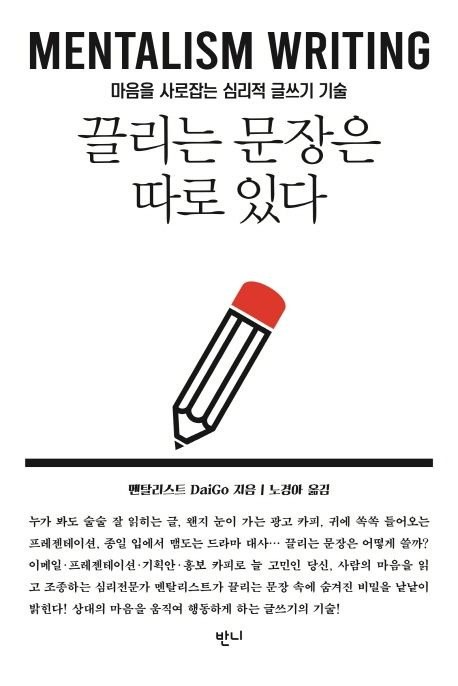
Curious how writing moves people in the first place?
The last post explained it, so read that one first.
You don’t write to be read - a review of 끌리는 문장은 따로 있다, part 1
Learning the techniques matters, but you only use them well once you understand the principle behind them.
Today’s five techniques are making a first impression, variation, reading the reader, stirring emotion, and adding a postscript.
One line each.
-
Predicting the reader’s mind: imagine you’re talking to the person, and you can build a piece that answers their questions and reactions in advance.
-
Making emotions rise and fall: writing that stirs emotion is what gets remembered. Start positive, add something unfavorable in the middle, finish positive again, and the range of feeling makes it stick.
-
Variation: saying it once doesn’t get the message across. Keep varying the same message in different forms.
-
Making a first impression: just starting on a positive note changes the impression.
-
Adding a postscript: the short line in the P.S. is what people remember most. It has nothing to do with the rest, so put what you want to say there and leave it in their head
Apply one or two of the five and you can move a reader.
But five is a lot to remember, isn’t it?
So! I’ve sorted them into three stages you can apply as you write
To write easily, write in three stages
Anyone can write easily by working in three stages.
Stage 1, planning: first, decide what you want to say.
Good writing always has a purpose - 1 - good writing changes the reader
Stage 2, structure: decide how to deliver what you want to say.
Stage 3, writing: turn what you decided into sentences and finish the piece.
There are more stages after this, revision and the rest, but skip those for now. This much already puts you above average.
Shall we take them one at a time?
1. Planning: plan as if you’re talking to a curious friend
The first stage is planning. Planning is the hardest part, honestly. Plenty of people don’t know what they want to say.
Here, think of it as a conversation with a friend (or a KakaoTalk thread).
You throw out the first thing that comes to mind, and your friend keeps asking for the reasons or the conclusion.
Answer those questions one by one and you find what you actually wanted to say.
Here’s an example, a post about reading that I’m working on now.
Me: I want to write about speed reading
Friend: do you need speed reading?
Me: more information means better decisions (link to the Kelly criterion attached)
Friend: reading a lot doesn’t mean you remember it all, does it?
Me: fair, so maybe it’s better to read good books several times
Friend: so reading fast isn’t that important?
Me: right, reading fast is pointless if you take little from it.
Friend: so what you want to say is “the best way to read is to read good books several times and think about them”!
(if you have actual friends, feel free to use a real one)
Few people really have this conversation with a friend. Either way, imagining someone who questions what you say lets you settle the center of the piece.

Imagining that conversation, I can set the core message and the reasons behind it, like this.
Core message: read good books several times. Speed doesn’t matter.
Reason 1: the more good information you have, the better your decisions.
Reason 2: a handful of good books still have something to teach on a reread. (More than an ordinary book does.)
Reason 3: the point of reading is getting good information, so what you take from it matters more than how fast you read.
2. Structure: repeat with emotion and variation
Once you know what you want to say, you decide how to deliver it.
Two things to remember here, “making emotions rise and fall” and “variation”.
Start with the first technique, “making emotions rise and fall”.
As the earlier post covered, we write to change the reader’s behavior.
And changing behavior means stirring emotion.
How do you stir emotion?
Simple. Have them feel good and bad by turns. A wider swing makes the impact stronger.

At its simplest you can build the swing inside the sentences themselves.
(positive) Apply one or two of the five and you can move a reader.
(negative) But five is a lot to remember, isn’t it?
(positive) So! I’ve sorted them into three stages you can apply as you write
The second technique is “variation”.
Hearing the same message repeated ten times makes it 86% more persuasive, apparently.
So should you just repeat the same words ten times?
No. Repeating the same words gets boring.
So how do you repeat without boring anyone?
Simple. Keep the filling (the message) and change the wrapper (the wording), and you can repeat without the boredom.
That’s what variation means.
Here’s an example. If the core message is “you should read to make better decisions”, the variations can go like this.
Variation 1: what’s the decision you regret most in your life? What if there were a way to live without the regret?
Variation 2: Elon Musk says his strength is decision making. Can we steal that ability?
Variation 3: the choices we make every day, and what comes of them, decide whether life gets better. Let me show you how to change yours.
Same thing three times over, but change the wrapper and you can persuade without boring the reader.
Want practical tips that make you a little smarter every week?
I cover persuasion, marketing, writing, and the other skills modern life demands.
Subscribe now and get notified when a new post goes up!
3. Writing: turn the outline into sentences
All that’s left is turning the outline above into a piece. I’ll cover the writing stage in more detail another time.
Instead, here’s the last technique. “Adding a postscript”.
If there’s something you want to say that has nothing to do with the topic, put it at the very end as a P.S.
The thing you write last is what stays with people.
When the topic is fixed, like a work email, the P.S. is the one space where you can say what you want, so it’s worth using.
For a good example, I put my usual thinking in a P.S. at the end of this old post.
Three ways to make people read your stuff - 3 - drive 3: be a good attention seeker
It has no direct link to the topic, so dropped in the middle it would have felt off and been forgotten fast. In the P.S. it seems to have stayed with readers. They remembered it and brought it up in conversation.
That’s the three-stage method for writing well without much pain, and the five techniques that make it easier.
To summarize.
Write as if you’re talking, and work out what the reader will wonder about and how to convince them.
Build the swing of feeling, and vary the core message.
Open on a positive note, and put the unrelated thing you want to say at the end.
Wrapping up: anyone can write something people are drawn to
That’s three weeks of taking 끌리는 문장은 따로 있다 apart.
We covered more than the book holds. The book has plenty of examples, though, so it’s worth reading.
If you forget everything else, I hope this one sentence stays with you.
When you write, don’t put your own thoughts down as they are.
Think about what you’d have to say to move the person reading.
Writing isn’t a plain delivery vehicle for information.
We write to move readers and lead their thinking. Build the swing of feeling, vary the message and repeat it, and the reader changes without being pushed.
I hope you write like that.
P.S. The book doesn’t cover this, but something matters more than the writing. The title.
However well written a piece is, it changes nothing if it doesn’t get attention. A boring title does exactly that.
Want to know how to write a title that pulls readers in? Read this.
Three secrets of a title you can’t scroll past - writing titles that pull a million views
Want practical tips that make you a little smarter every week?
I cover persuasion, marketing, writing, and the other skills modern life demands.
Subscribe now and get notified when a new post goes up!