The last post looked at why having more information gets in the way of a decision.
(I recommend reading that one first)
We also learned that the value of information sits in its quality, not its volume.
So what is quality of information exactly, and how do you put a value on it?
Let’s get at the secret of the information behind the best decisions.
The Kelly criterion that hacked the casino and the stock market
Someone worked out what a good decision needs.
The American mathematician John Kelly.
 Bright, alert eyes on him. Source: Wikipedia
Kelly studied the odds on casino roulette and built the Kelly criterion, the formula that wins the most money.
He used it to clean up at roulette and blackjack.
The casinos ended up barring him, and Kelly, bored, turned to the stock market.
Where he made even more.
The Kelly criterion later turned out to be one of the highest returning formulas in the stock market, and Warren Buffett used it too.

The formula is simpler than you’d expect.
G max=R
R is the accuracy of your information. G is your return, so G max is your maximum return.
Which is to say, you cannot earn a return higher than the accuracy of your information.
Which stock will go up, which job to take, who to marry. The more precisely you know, the better the result you can make.
The accuracy of your information decides everything
Since good decisions make for a happy life,
you can also read this as “my happiness is decided by the accuracy of my information”.
The point is that happiness rides on the accuracy of your information, not the amount of it.
Knowing a little precisely beats knowing a lot of things badly.
 It also carries the lesson to concentrate on the one thing you do far better than anyone else, which ties back to the competitive advantage I covered in an earlier post.
So we know the accuracy of our information matters. Now let’s see how to use it.
The success equation for information and confidence
If how accurate my information is decides my returns, my competitiveness, and even my happiness,
then how exactly should I use information to get the best result?
Just do what Kelly’s “betting formula” says.
Kelly’s betting formula is fairly simple too.
P-(1-P)/A=X
P is the probability of winning and A is the payout.
X is the fraction of your money to bet to win the most.
(X=0.1 means betting 10% of your total assets, 0.5 means 50%)
Which is to say, you win the most by sizing your bet to your odds and the pot.
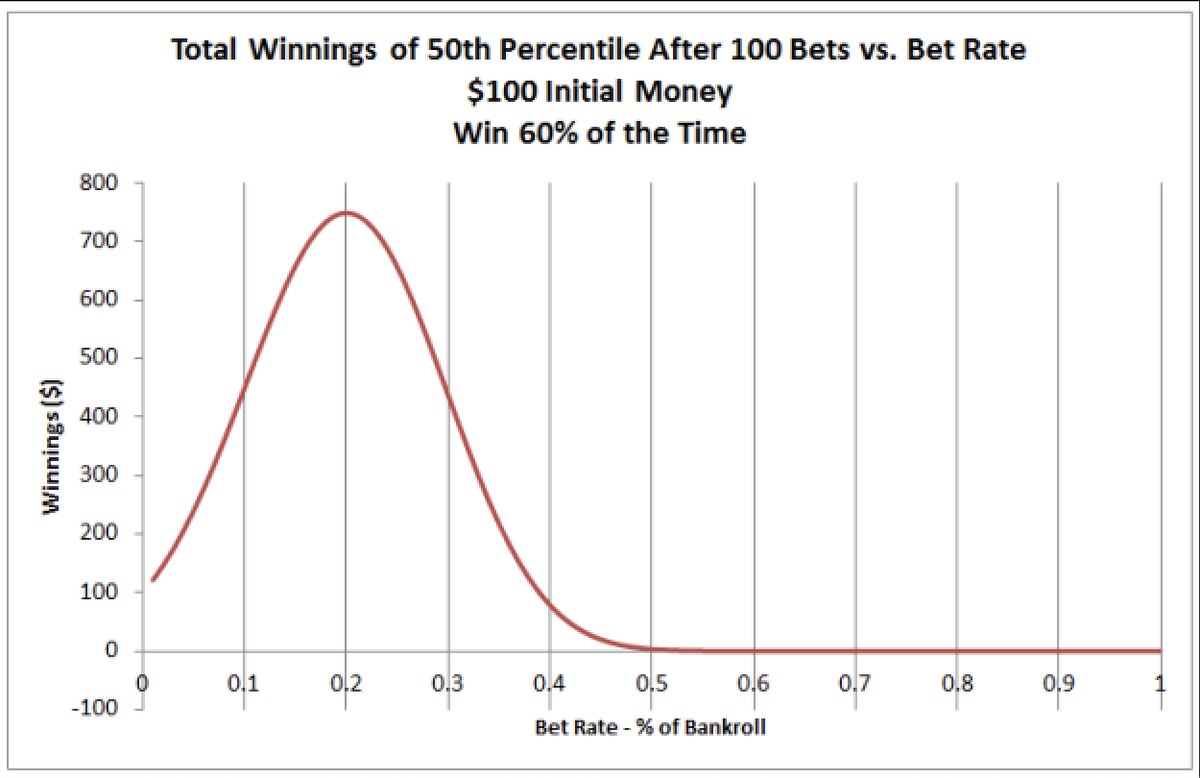 Source: http://www.fairlynerdy.com/kelly-criterion-for-betting/
As the graph shows, betting the 20% the formula calls for gives the best result.
Let’s put the betting formula into life.
The size of the bet is the size of your confidence, and the odds of winning are the accuracy of your information.
So you get the best result when you go at something with as much confidence as (your information + the payout) justifies.
(Which also means being conservative in a field you don’t know well, or when the payoff is small)
Which is to say, success is decided by good information and the right amount of confidence.
But in life we don’t get to set the payout.
You don’t decide the salary at the company you’re applying to, or the person you want to meet, or a stock’s return, do you?
The only thing we can change is the purity of the information we hold.
If you want a happy, abundant life, work at getting accurate information and hold the right amount of confidence.
 The balance between knowledge and confidence is what matters.
And now it’s clear why the overconfidence of the racing analysts from the last post is dangerous.
So is everything solved?
But life has no probabilities
Did it strike you that the Kelly criterion would be hard to apply to life?
Sharp of you.
To apply the Kelly criterion to your life, you have to know the odds on whatever you’re taking on.
But can you really be sure the odds of getting the job are 60%, the blind date going well 55%, the exchange rate rising 40%?
You can’t. Unlike roulette, where the odds and the pot are clear, real life is complicated and hard to predict.
You’d have to apply to the same company dozens of times and go on dozens of blind dates under the same conditions to know your odds, and you can’t.
You could guess at the odds from past experience, but the guess won’t be accurate.
 You can calculate the odds on dice. Not on life.
This is a problem. Knowing the odds is all it takes to get the best possible result, and the odds are what we can’t work out.
Is there a way to win without knowing the odds?
Surprisingly, there is.
In the next post, let’s look at the Martingale strategy.
And let’s work out what the real problem is that we have to solve, and how to solve it.
P.S. The happiness in this post is closer to benefit. Benefit is quantitative, happiness is qualitative.
The strategy that beats the average every time - decision-making series 3: three fatal mistakes
References:
Kelly, J. L. (1956). A new interpretation of information rate. the bell system technical journal, 35(4), 917-926.
https://en.wikipedia.org/wiki/Kelly\_criterion
https://en.wikipedia.org/wiki/Noisy-channel%5Fcoding%5Ftheorem
https://blog.naver.com/ranto28/222883263853
https://www.dailyfx.com/forex/market%5Falert/2021/12/25/The-Kelly-Criterion.html
https://ergodicity.net/2012/04/11/the-history-of-the-martingale/