The decision-making series, all three parts
1. Why studying more makes you dumber - is more information always better?
3. Three ways to avoid the worst - overconfidence and reasoning ability
As the last post covered, accurate information is the most important thing in a good decision.
And you get the best result when your confidence matches the accuracy of your information.
But there’s a problem.
Life has no probabilities.
We have neither the quantity nor the quality of information to predict the future. That goes for experts too.
Philip Tetlock, an American professor, asked 300 experts to forecast the future and scored them. The experts turned out to forecast about as well as a monkey guessing at random. Without conditions that let you gather good information and learn from it, an expert isn’t much different from anyone else.
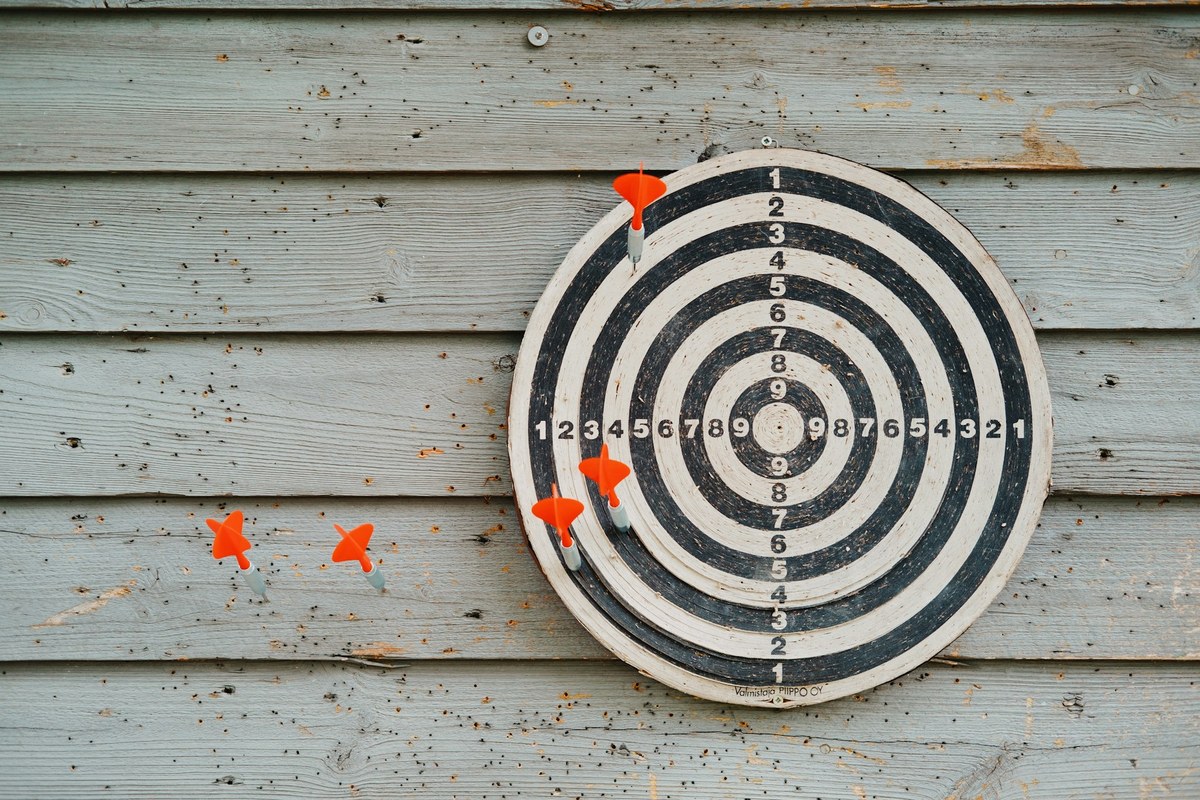
An expert who has practiced their whole life still can’t predict the future without information.
So is there a strategy that always wins, whatever information you have?
The Martingale strategy that always wins
In theory there is one. The Martingale strategy.
Martingale is simple.
Place a bet.
Lose the bet, and bet double what you lost.
Every time you lose, double the stake.
Repeat until you win and have all your losses back.
Under Martingale, a single win recovers everything you lost and then some. If your odds are anything above zero, you win eventually, guaranteed. So keep trying and one day you win.
Example) You bet 10,000 won, lose and bet 20,000, lose again and bet 40,000…
If you win on a 640,000 won bet, you take 1,280,000 won, cover every loss so far, and come out 10,000 won ahead.
So can we carry a “I’ll just win it back!” attitude, raise the stake every time we fail, and eventually win for sure?
 Because you can just win it back (source: Gambling Apocalypse: Kaiji)
No. Martingale is useless in real life, because in life you can’t raise the stake forever or keep trying forever. We can’t borrow money without limit, and we can’t grow the stake without limit.
Which makes Martingale a strategy that bankrupts you sooner or later. That chance of going bust is exactly what separates the Kelly strategy from the Martingale strategy, so let’s look at why it matters.
Want practical tips that make you a little smarter every week?
I cover persuasion, marketing, writing, and the other skills modern life demands.
Subscribe now and get notified when a new post goes up!
The destructive power of multiplying by 0
Why is the Kelly strategy better than the Martingale strategy?
Because it’s far safer. The Kelly strategy is unlikely to blow through your stake.
As we saw in the last post, the reward is proportional to the stake, and the stake is proportional to the money you’re holding. The less money you hold, the smaller the stake, and so the smaller the reward. And if your money hits 0, the reward you can get is 0 too.

It’s worse than being at a disadvantage. You lose the chance to recover at all. However big the pile, multiply it by 0 and every chance of getting back up goes with it. Martingale looks like it can only produce a good outcome, and in real life it can only lose.
Handling uncertainty
The Kelly criterion needs probabilities to work, and the Martingale strategy, which needs none, always loses.
Is there another way to decide well?
Is there a way to make good decisions in a reality full of uncertainty?
The University of Michigan tested how well people predict, and the result points at a decision strategy we can use in real life.
In the experiment, you guess the color of a ball in a bag.
The bag holds red and blue balls in a 7:3 ratio, and the experimenter draws them out one at a time at random.
Participants just have to call red or blue right as often as they can.
 How do you guess the color of a random ball?
How would you predict?
Most participants called red 7 times and blue 3 times.
They predicted at the 7:3 ratio of the two colors. And then they tried to guess the order the colors would come in.
Were you going to do that too?
If so, you’d have called the color right about 58% of the time on average.
(0.7 * 0.7 + 0.3 * 0.3 = 0.58)
But there’s a better way. Predict red for every ball and you reliably get 70% of them right.
You might not come up with that on the first try.
But participants kept predicting 7:3 even after thousands of repetitions.
The color of a randomly drawn ball can never be predicted, and rather than accept that, they kept trying to call it somehow.
Why couldn’t they predict any better than that?
Two reasons.
First, the participants fell into the illusion of control. You cannot call the color of a randomly shuffled ball. But the participants were overconfident enough to think they could, and put pointless effort into finding a pattern in the colors that wasn’t there.
Second, they didn’t think deeply. They needed to accept that predicting it 100% was impossible and then use second-order thinking to look for the second-best option that doesn’t come to you intuitively, and they didn’t.
(Second-order thinking came up in another post: <Why you shouldn’t blindly follow your gut> )
People don’t only behave this way inside an experiment.
Add overconfidence about predicting short-term trends in the stock market to a creative way of reading a chart, and any future at all starts to look predictable.
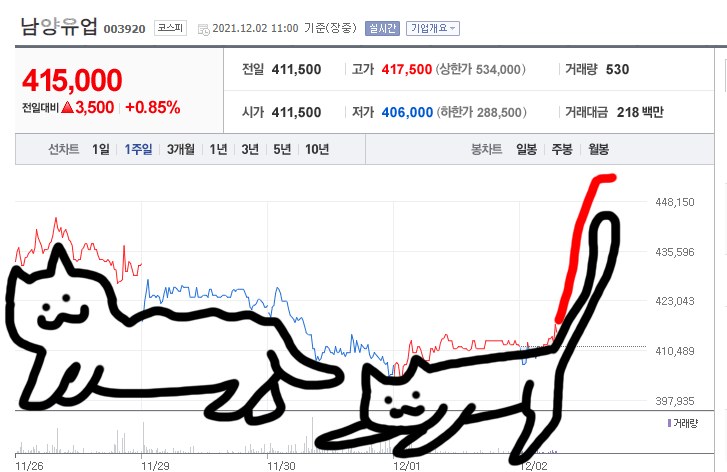 Wouldn’t it be lovely if the price rose like a cat’s tail? (source: FM Korea)
Can a retail investor predict the short-term trend of a stock price? Think it through and it’s impossible. But there are people drawing cats on charts today. Predicting your life from blood types, saju, or star signs is the same thing.
Predict what can’t be predicted and all you produce is guesswork. Denying that a situation is unpredictable doesn’t change reality. Focus on the information you’re sure of and make the best decision you can instead. Mistake not knowing for knowing, and think only as far as what’s in front of you, and you pay for it.
The secret to a good decision
Over three posts we’ve gone through how to decide well.
It comes down to two abilities. Good decision-making is reasoning ability and self-control.
Reasoning ability is the learning ability to gather more accurate information plus the ability to think deeply,
and self-control is the ability to not be moved by feelings like overconfidence, envy, fear, or laziness.
Which turns into three concrete instructions.
- Don’t let feelings shake you, 2) gather information you’re sure of, 3) think deeply.
Simple instructions, and as we’ve seen, hard to follow in practice.
Short of holding all the information, you can’t make the right call every time. In real life we always decide while carrying risk. Deciding well isn’t the unrealistic goal of always making the right call.
Instead it’s avoiding the mistakes and risks you can avoid even with incomplete knowledge. Always making the right call is unrealistic, because we have neither enough information nor enough time. The good decision available to us is the one that takes no unnecessary risk and doesn’t get fooled by the illusion of knowledge, by feelings, or by shallow thinking.
So let’s just remember the three mistakes to avoid at all costs.
1) Don’t be overconfident , 2) don’t be fooled by the amount of information, 3) don’t jump to conclusions
A good decision starts with avoiding a bad one.
Links to the three parts of the decision-making series
1. Why studying more makes you dumber - is more information always better?
3. Three ways to avoid the worst - overconfidence and reasoning ability
References:
https://www.lesswrong.com/posts/msJA6B9ZjiiZxT6EZ/lawful-uncertainty
https://ergodicity.net/2012/04/11/the-history-of-the-martingale/
Tversky, A., & Edwards, W. (1966). Information versus reward in binary choices
Books: “The Signal and the Noise”, “Clear Thinking”, “Same as Ever”