This was back when I had just started working as a developer. Right before I was going to leave for the day, I ran the code I had written and got an error I had never seen. Normally I would read the message and track down the cause, but not this time. All I got was one vague line saying a variable was defined wrong, with no explanation. Hitting this right at the end of the day was annoying and a little rattling, so I was just trying things at random.
 The error was about this vague.
The error wasn’t going anywhere, so I explained the situation to the senior sitting next to me. He hesitated for a few seconds, thinking, then said: ‘That’s probably an error from the dependency version changing. Want to try fixing it?’
He was right, and the error was gone right away. I asked him, ‘How did you know it was a dependency problem?’ He just said, ‘I mentioned this morning that I was updating dependencies, there were no other changes, and if it were our own code you don’t usually get an error message like that.’
Walking home that night, I kept wondering. We looked at the same error screen, so how did he figure out the problem that fast? And how do you learn a gut feel like that?
How to act like an expert
What’s different between him and me? What is it that experts have? Someone has actually studied this. Gary Klein is an American psychologist who researched people who make decisions in complicated, urgent situations: police officers, emergency surgeons, firefighters.
 Gary Klein (https://www.gary-klein.com)
We usually think decisions should follow rules, the way a computer solves a problem by following rules. But can you judge by the rules when the situation is complicated, the information is wrong or missing, and there’s no time to weigh anything? Can a firefighter sent into a burning building watch the flames and deliberate over which part to put out first? Every building and every incident is different, and there’s no time, so rules alone won’t get you there.

The stock market is the same. The exact same market conditions never come back, you just get situations that look vaguely familiar. You can’t decide by rule in that. You have to solve it with experience, intuition, and pattern matching.
The RPD model (Recognition Primed Decision Model) that Gary Klein developed describes how people make experience-based decisions under pressure.
Want practical tips that make you a little smarter every week?
I cover persuasion, marketing, writing, and the other skills modern life demands.
Subscribe now and get notified when a new post goes up!
The RPD model: spot - search - imagine
Gary Klein’s RPD model looks like this. There’s a Korean version here too.
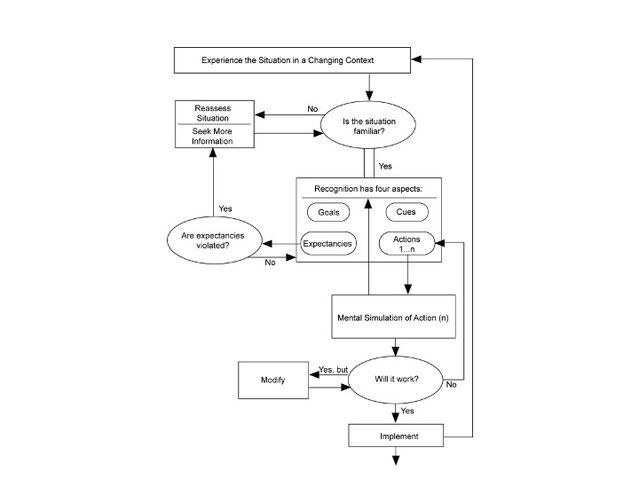 The RPD Model, by Gary Klein
All the lines make it look complicated, but the core is three steps.
-
Spot: find the key features (the signals) in the situation in front of you.
-
Search: look through the experiences tied to those features for a similar case. (If the comparison doesn’t match, go back to 1 and look for other features.)
-
Imagine: build a solution out of the one that worked in the case you recalled, and imagine (simulate) the result. (If the simulation doesn’t look like it will work, go back to 1 or 2 and pull up a different experience and solution.)
The core of the RPD model is not following whatever memory surfaces, but comparing actively and putting the result to work. You find the closest experience from the features you caught, and the simulation step is where the gap between that experience and the situation in front of you gets closed, so the experience applies accurately.

Look closely and the ‘intuition’ that makes someone seem expert is not shaman-like magic, it’s experience used fast. Instead of reflexively following the memory that pops up (System 1), we get the most accurate intuition when we run experience (System 1) through the RPD model (System 2).
To sum up, RPD is a way to solve problems that can’t be defined. Which covers nearly every problem life hands you. Years on the job and gut feel, intuition and insight, all of it is a pattern-finding game, and RPD is the method for finding the pattern.
P.S. Building skill also takes review and reflection. But as the old saying goes, winning and losing are everyday business for a soldier, and a decision made in a complicated situation can’t be judged by its outcome alone. Making money doesn’t automatically make it a good investment, and a spacecraft exploding doesn’t automatically make the decision to launch a bad one.
So how do you tell whether a decision was well made? Gary Klein’s CDM (Critical Decision Method) shows you what was good and what was thin in your own decision process. It also lets you dissect how an expert decides, so you can absorb what they can do!
In the next post I’ll go through what CDM is and how to apply it without much trouble.
Want practical tips that make you a little smarter every week?
I cover persuasion, marketing, writing, and the other skills modern life demands.
Subscribe now and get notified when a new post goes up!
References: articles (1, 2), Thinking, Fast and Slow, Think Again, Social functionalist frameworks for judgment and choice
You might like these too!