This series covers how to read faster, and the reading methods that beat speed reading.
The reading series collects what Prody puzzles over and works out, in a life that is mostly eating, reading books, and writing on Brunch.
Last week we worked out what good reading is.
Good reading is reading that builds your problem solving. I really do recommend reading that one first.
What if you read ten times faster? - reading series 1: how to read well
Read 10 books or 100, and if it doesn’t build your problem solving there was no point. We also learned the four-step method that builds it efficiently: record, summarize, connect, repeat.
-
Record: note or mark whatever interests you as you read
-
Summarize: sum up what you learned to lock it into memory
-
Connect: link the thoughts together and put them to use
-
Repeat: reread the good books and run steps 1 to 3 again
Today let’s go through the four-step method for reading a book more deeply in detail.
How a pragmatist reads
1. Record: note the interesting parts as you read
A book runs about 300 pages. But gather up only the parts worth remembering and you get maybe 10 pages. The other 290 exist to introduce and explain those 10, so you don’t have to remember them. Our time and our memory have limits. You can’t read a whole book at full attention, and you don’t need to. Even with a long book, pull out the core, remember that, and apply it to your life.
So as you read, underline the interesting parts or write them in a notebook.

When you underline, don’t just copy the sentence. Ask why that sentence matters and how it connects to your life or your thinking. Record it this way and rereading the book takes under 10 minutes, because you only look at what you marked.
When you underline, it’s even better to write the thought that came to you next to it. Putting your own thoughts in a book pulls you out of passive reading, where you only take information in, and into active thinking. Here’s what I usually write down.
Why this part caught my eye
How it connects to something else I’ve read
What I’m curious about or doubt
How I could use this

You forget the text you read, but you remember the words you wrote. A book holds only the author’s thinking. The thought you wrote beside it is yours.
Once you’ve recorded, it’s time to organize.
2. Summarize: sum up what you learned to lock it into memory
Once you’ve read the book, summarize it. Doing it in your head is fine, writing it down is better.
A summary is basically the process of answering two questions: the topic, and what you learned.
-
[Topic] What is the author trying to say? Is the argument sound?
-
[What I learned] Which part is most interesting? And why?
Even five minutes summarizing what you just read is enough to understand a book deeply and remember it well.
Summarizing is the act of understanding a text. It isn’t just making the text shorter. A real summary is digestion: rearranging the text into an order that means something. You break the flow the author laid out and reassemble it along your own logic, and in doing that you understand the text more deeply. Normally you read passively, but while you’re summarizing you actively judge the structure and the logic.
Summarizing also helps your memory a lot.
Think of the last book you read.
How much of it do you remember?
And the book before that? Probably almost none of it. That’s normal.
Look at the Ebbinghaus forgetting curve and you’ll see that people forget newly learned material within a week.
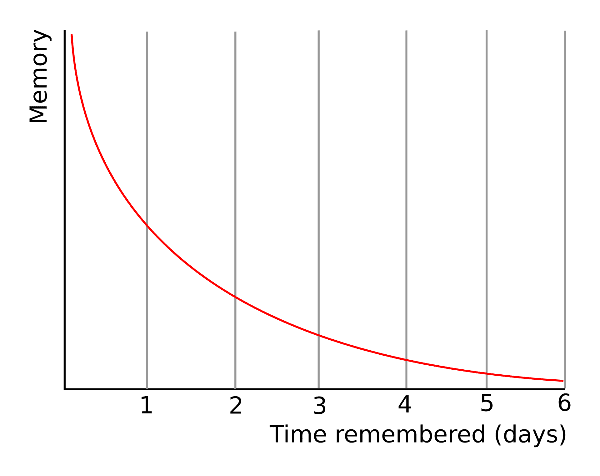 The Ebbinghaus forgetting curve (source: Wikipedia)
Feels unfair, doesn’t it?
But the forgetting curve also tells you how to hold on to a memory. Review. Review something repeatedly and the memory gets stronger. Review isn’t hard either. You just have to recall it once before you forget it.
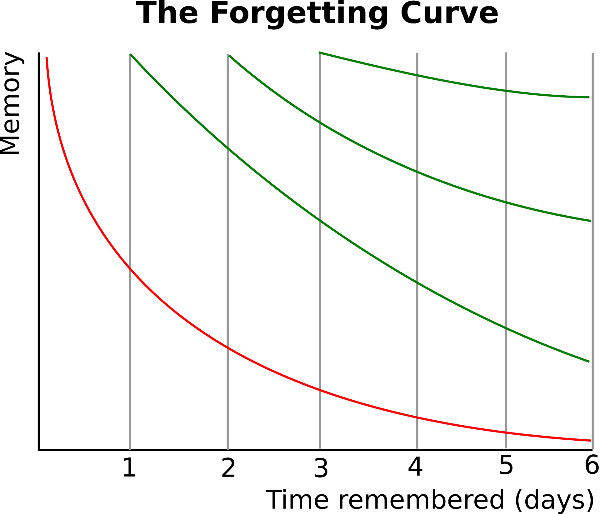 The forgetting curve with review (source: Wikipedia)
Briefly summarizing what you learned is a review method backed by neuroscience and education research. Studies find that output, putting it in your own words, strengthens memory more than input, rereading it several times.
As I said above, knowledge you take in isn’t yours. Only knowledge you put back out is.
Want practical tips that make you a little smarter every week?
I cover persuasion, marketing, writing, and the other skills modern life demands.
Subscribe now and get notified when a new post goes up!
3. Connect: link your thoughts together and put them to use
Steps 1 and 2 have turned a lot of books into short pieces of knowledge. Can you solve real problems with what you’ve collected? Plenty of problems can be solved with a single book. But the world is full of complicated problems, and those need several pieces of knowledge connected and applied together. Some simple breakdowns you can fix with a drill alone, but a big one takes more tools. So you have to practice connecting new knowledge to what you already have and using it in real life. That’s how you build the problem solving that reading is for.
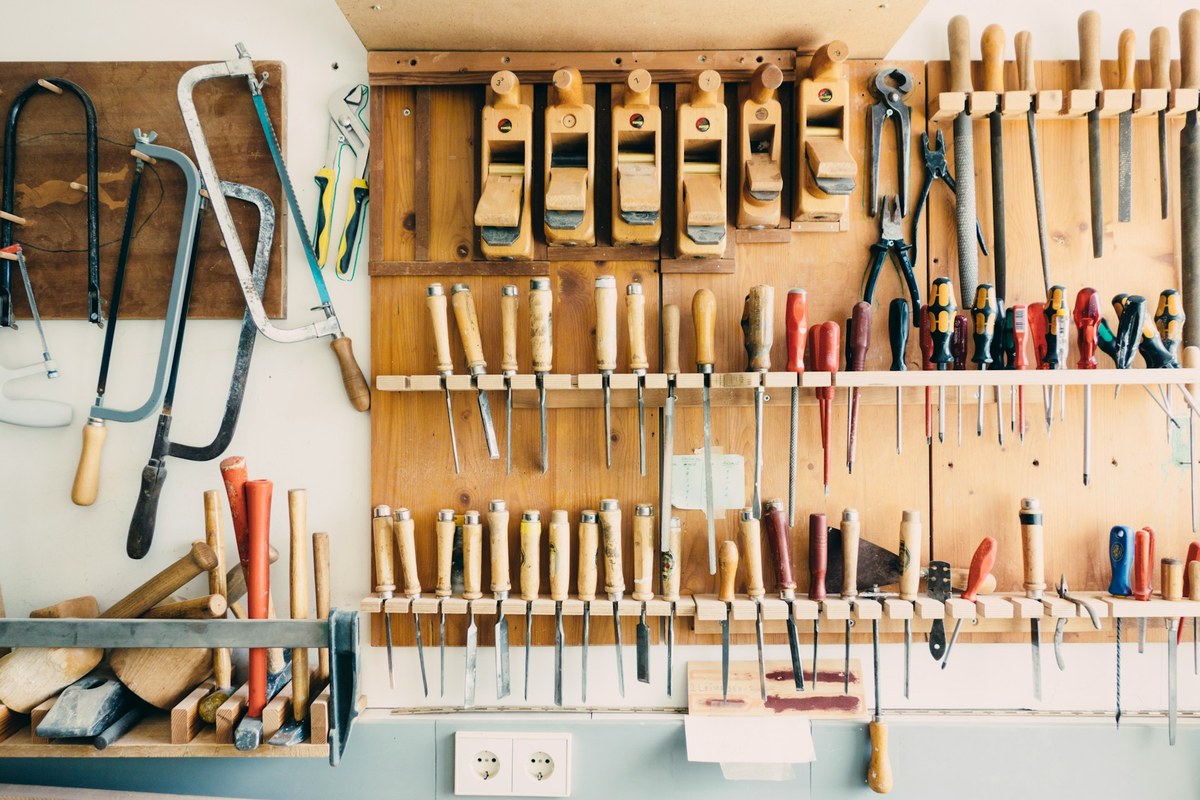
Connecting means linking pieces of knowledge and applying them to reality. Say you learned persuasion strategies from several books. You work out how two of them could be mixed, then find a way to apply that to the customer you’re handling. Knowledge that can’t solve a real problem is pointless.
One good way to connect knowledge is the Zettelkasten. It’s a method for linking paragraph-sized fragments of thought. It’s efficient because the more thoughts pile up, the more ways you can connect them. Niklas Luhmann, the professor who invented the Zettelkasten, used it to write 70 books and 400 papers, which tells you how productive the strategy is. I use a simplified Zettelkasten myself to organize my thinking and publish here every week.
Zettelkasten isn’t the easiest thing to adopt, so I’ll explain it separately when I get the chance. For a good introduction I recommend Sönke Ahrens’s book ‘How to Take Smart Notes’.
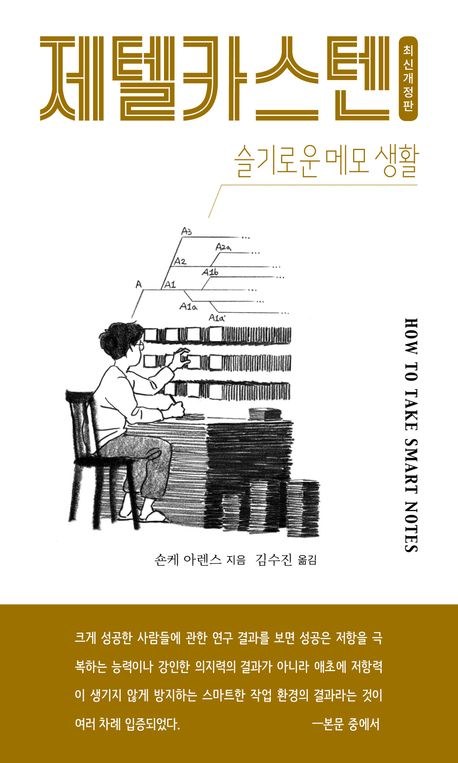 (source: Kyobo Book Centre)
To sum up, knowledge gets its real value only when you connect what you learned and apply it to reality. Reading is finished only when you connect and combine knowledge in different ways to solve a problem.
4. Repeat: reread the good books and run steps 1 to 3 again
Every book gives you a different amount of knowledge. Some are good and some are a waste of time.
How good a book has to be to count as good is up to you. My view is that if I salvaged even one sentence from a book, it wasn’t a bad book. As long as that one sentence was worth more than the 20,000 won and the three hours. How to pick good books is for another post. Filtering out bad ones I covered earlier.
Three ways to avoid a bad book - enough with the success-peddling books!
Anyway, the time-wasting books you can sell to Aladin’s used bookstore or use as a pot stand. Good books are the problem. Reading a good book only once is a big loss. The Pareto principle applies to books too, so most of them are mediocre and everything worth learning is concentrated in the few good ones.
A good book teaches you something new however many times you read it. The text doesn’t change, but you, the reader digesting it, change your view, so it’s new every time. And rereading the same book takes hardly any time. You just go back over what you recorded before and turn the meaning over again. Once that material gets familiar it won’t even take 10 minutes. And the more you read this way, the stronger the memory and the more new knowledge stacks up.
Repeating record, summarize and connect on good books to build your problem solving is how a pragmatist reads.

Reading isn’t a shopping list.
Posts and videos along the lines of “I read X books and my life changed!” keep showing up. If a life really changed, that’s worth celebrating, and raw volume does matter, but I worry this turns reading into a race, or a shopping list.
Standing in front of a reading list, don’t rush. Be humble.
 Reading all 240 recommended books won’t make you Bill Gates. (source: mostrecommendedbooks.com)
Like a package tour, piling into a famous sight, taking a few photos and buying a keychain doesn’t necessarily make the trip mean anything. Go to Paris, miss the Eiffel Tower, but wander the streets and come away with something you felt, and that trip meant something. Reading is the same. In the end what matters is how much you felt.
Reading the pragmatist’s way, recording and connecting what you learn over and over, has another benefit: you stop obsessing over the count. Hearing that people around you read 20 or 30 books a month can make you anxious. You start comparing, wondering if you’re too slow.
But once you record what you learn, you can see how much you’ve learned and grown. You stop comparing yourself to others and focus on your own learning. Feeling anxious about whether you’re doing well is normal. People get anxious when they have no standard. Which is why you need your own. On any day you read, 10 pages or a whole book, call to mind what you learned. Read one line and learn something from it, and the reading worked.
When do we get to the speed reading?
Now that we know how to read, it really is time for the speed reading techniques.
Do you envy the people who read 10 books an hour?
Will we finally learn to speed read, leave work an hour in and live an easy life?
Is there even such a thing as speed reading?
Next week let’s look at the speed reading that science has actually proven.
Want practical tips that make you a little smarter every week?
I cover persuasion, marketing, writing, and the other skills modern life demands.
Subscribe now and get notified when a new post goes up!
Read the next post:
References
-
Book: Writing to Learn, William Zinsser
You might like these too!
Why studying more makes you dumber - decision-making series 1: is more information always better?
Why you should never stack side jobs - staying in your circle of competence
How to persuade in one sentence - The One Sentence Persuasion Course, part 1