Today’s post gathers up what I’ve been working through.
The hardest part of writing a weekly series is choosing the topic. So I’m always turning over which book to cover and how to cover it. Maybe it gets easier the longer the series runs, but the question of which knowledge is most useful seems hard by nature.
While I’m working out how to handle a book, I read it several times. The one I’m preparing now is Nonviolent Communication, which teaches you how to resolve conflict. Sometimes I reread only the underlined parts, sometimes the whole text. I’ve been through this one at least three times. I’d filed it as an ordinary self-help book, and it changed how I look at the world.
 Thanks to the SNULife alum who recommended it
I’m certain I read it carefully, and every reread turns up something new. Strange, isn’t it? Like a kaleidoscope.
 Source: https://giphy.com/gifs/justin-kaleidoscope-xT39D6ljE4N3kBJs7S
Not one letter of the book changed, so why do I keep finding new things in it? Probably because the person reading it changed.
Sometimes what I find is interesting, and sometimes it’s deflating. Why didn’t I catch it the first time? Do I read so shallowly that it takes several passes just to understand the text?
The books I’ve decided I should read, at minimum, come to about 120.
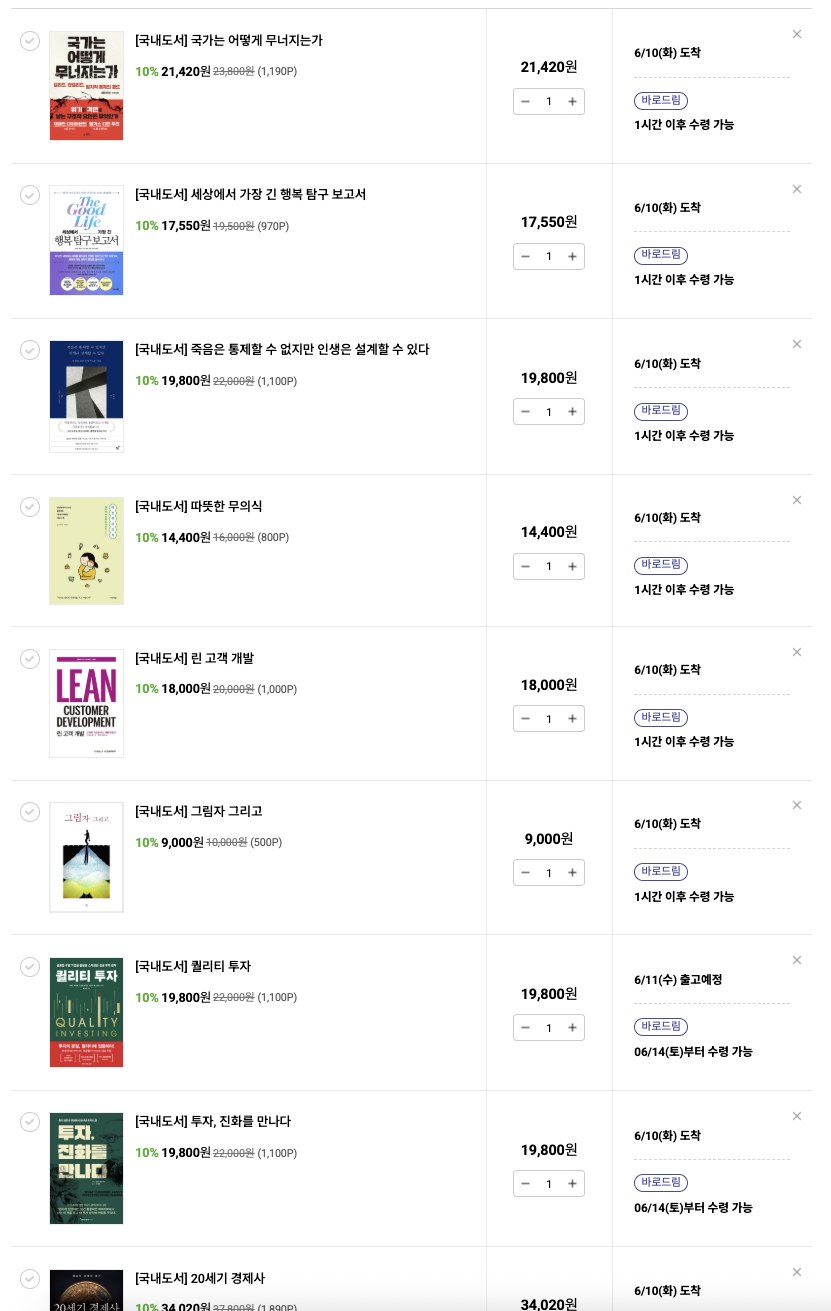 Stacked up in my Kyobo Books cart and on my Millie’s Library shelf.
I find books to read faster than I get through them. Ironic, isn’t it? Though maybe it’s the obvious outcome.
As I explained in the first post of this series, the world is very complicated.
Why you can’t draw a doorknob - the world is complicated and prediction is hard
So no matter how hard I work at it, there’s always material left that I don’t understand.
In Zeno’s paradox, Achilles can’t catch a tortoise slower than he is. I’m racing a tortoise faster than I am. Every time I look at the unread books I’m reminded how far short I fall. Not a pleasant feeling, though I’m used to it by now.
Want practical tips that make you a little smarter every week?
I cover persuasion, marketing, writing, and the other skills modern life demands.
Subscribe now and get notified when a new post goes up!
The growing antilibrary
The pile doesn’t just sit there, it grows. Nassim Taleb, a writer I like and have written about before, says it’s natural for your antilibrary, the list of books you haven’t read, to grow and to frighten you.
A library should be filled with books about what we do not know. As you age, knowledge accumulates and the books you have read stack higher, but the unread books on the shelves keep growing too, and they frighten you. The more you truly know, the longer the row of books you have not read. (The Black Swan)
As Taleb says, the more you know the more you realize you don’t know. So the antilibrary grows on its own. That’s the unknown unknown idea I covered in an earlier post.
Unknown unknowns and picking lottery numbers - when you have to act before you know
Should I shrink the antilibrary? Shrinking it doesn’t make the unread books disappear. Close your eyes and the world is still out there. The method that comes to mind is getting better at picking good books. That’s not a simple topic, so I’ll take it up separately another time.
Let’s rethink reading and the library instead. Is a book I’ve read really “my book”? I thought so until recently. But going through Nonviolent Communication again and again while taking notes, I kept running into things I still don’t know. It struck me that I hadn’t understood even half of it. Having something in front of your eyes doesn’t mean you see it, and reading it doesn’t mean you know it.
Resolving conflict with nonviolent communication - Nonviolent Communication (NVC) - 1
Can I claim the books on my shelf, the ones I’ve read, as conquered knowledge? I’m sure I can’t. If the same book gives me something different on every pass, one or two passes don’t entitle me to say I know all of it. So I’ve come to think neither the library nor the antilibrary tells me how well I’m doing.
My real library, meaning my knowledge, isn’t the books I’ve read. Only what I’ve written myself, understood fully and digested and rebuilt in my own words, earns a place on that shelf. Which leads to a different topic: writing as study. Writing is the best study tool there is. Pushing what you’ve taken in back out in your own words gets you a deeper understanding, and it shows you what you don’t know. That’s why I’ve covered how to write.
Why does Sam Altman switch notebooks every two weeks? - working memory and the writing problem
So I decided that learning better means writing. That’s why I started on Brunch, working out how to write well.
Prody’s writing class magazine
But writing isn’t the answer to every problem. Knowledge isn’t for storing in your head, it’s for using. The reason we build knowledge and try to understand the world is to make the future, even if the understanding is worth something on its own. The future isn’t predicted, it’s made.
You don’t need to predict the future - thinking like Discord and PayPal
I started this series from the worry that the world is complicated and prediction is hard. What came out of it is that action matters more than prediction, that you should say only what you know, and that useful knowledge beats accurate knowledge.
Piling up knowledge so you can predict the future is a passive stance, and it changes nothing. You have to build the world with the incomplete knowledge you have. To make a future that doesn’t exist in the reality we already have, the ability to see reality as it is matters more than refined knowledge. Knowing isn’t even half the problem.
This feels like a good place to end the series.
[Serialized Brunch book] Riding a complicated world
Want practical tips that make you a little smarter every week?
I cover persuasion, marketing, writing, and the other skills modern life demands.
Subscribe now and get notified when a new post goes up!
You might like these too!