Here’s what the story series covers.
Why do we love stories?
How to build a good story
How to change what people do with a story
One day in 1978, the crowd in front of a McDonald’s was as thick as ever.

Then a rumor started moving mouth to mouth, that the burger patties were made out of worms, and the mood turned fast. Head office denied it again and again. People didn’t believe them.
The weekend lines got visibly shorter, some customers asked the crew “is that true?”, and even the crew stood there looking rattled, waiting for instructions from head office. Some locations lost 30% of their sales.
There was no evidence, and nobody knew who said it first, but for plenty of people the story was already fact. McDonald’s ended up explaining itself over and over, in ads and in statements. Not one piece of evidence, not one witness, and people still believed there were worms in the burgers.
The rumor eventually died down, but it came back in 2014 and 2017 and went around Facebook all over again. (It is false, for the record.)

One story shook the sales and the reputation of the world’s biggest company for forty years.
So why are stories this strong, and how do they do it?
Is a story stronger than a gun?
Stories, and rumors and gossip more broadly, start trends, sink companies, and turn elections around.
Stories have a heavy effect on the real world. They change people’s minds and travel fast by word of mouth.
That makes a story the core skill of marketing, and the force that builds and runs an organization.
I wanted to learn where that power comes from.
In this series I’ll work through it with material from several books.
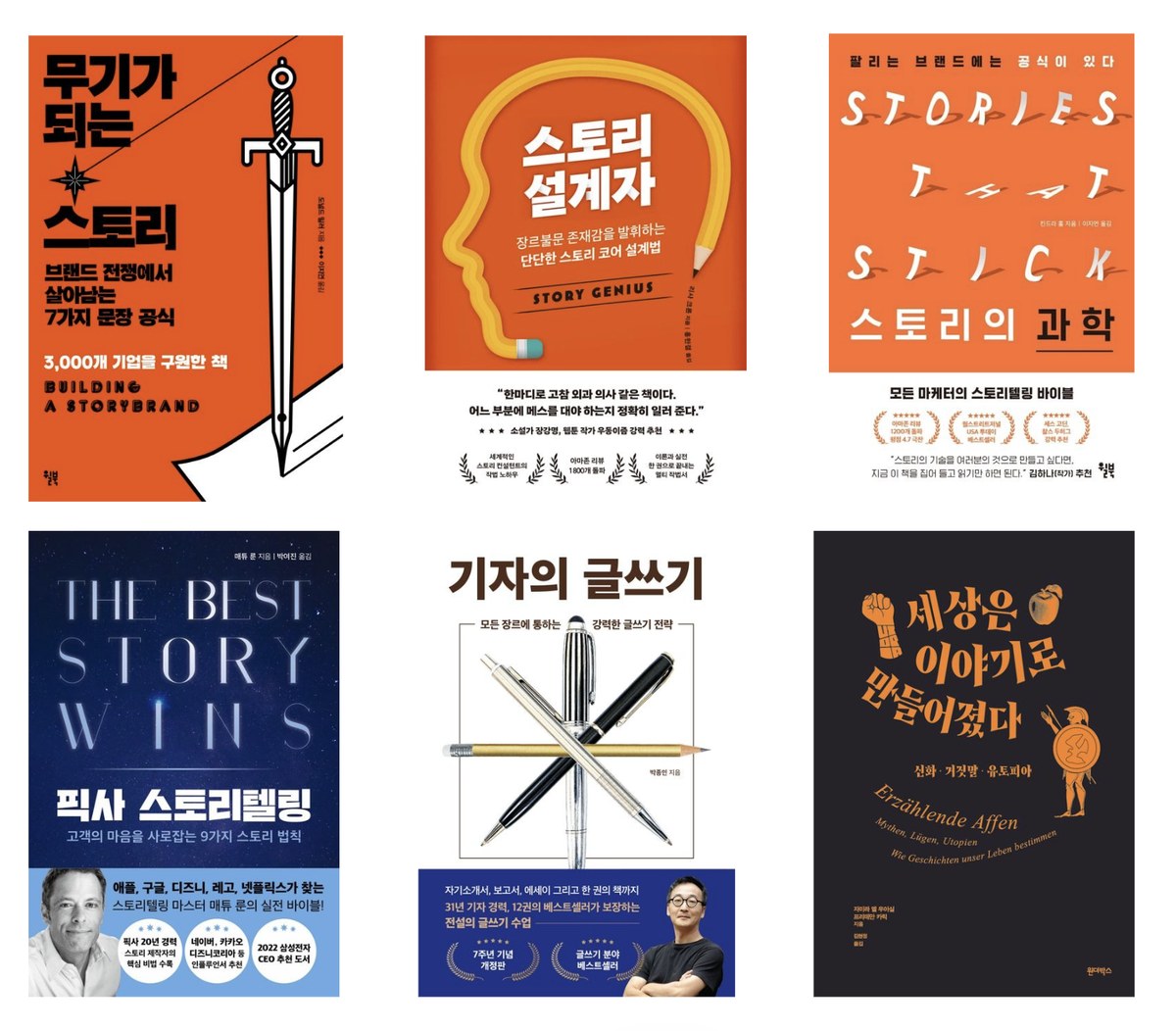 These are the main books I drew on.
On top of my notes from those books, with some brain science and psychology filled in, I want to look at what a story is and why it works, through four questions and their answers.
Q1. Why do we love stories?
Q2. What does story structure look like?
Q3. How does a story work?
Q4. What makes some stories survive?
First question first.
Why do we love stories?
The answer is simple. We learn about the world through stories.
1) We understand the world through patterns.
To survive, we store information and check it against what’s in front of us. Eat something good and you remember how you found it, the situation, the place, and use that later. Learning is really the storing of patterns for later use. You need patterns for dangerous things (don’t touch hot objects, watch your footing up high, avoid drunk people) and patterns for good things (where the good food is, the kind of person who suits you) before you can make good calls and stay alive.
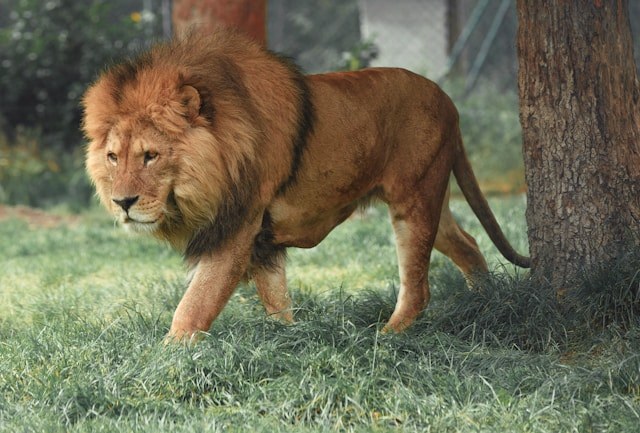 Lions, and most animals that look like lions, are dangerous.
Fail to build those patterns and you die. So we like patterns. We like MBTI, blood types, and saju readings, all of which sort people into patterns.
Some patterns you can put into words. (For example: ENTPs are usually nice.) Others you can’t. It sounds strange, but we learn patterns unconsciously as well. Single-celled organisms with no consciousness also learn, so it shouldn’t be that surprising.
2) We learn unconsciously too.
Adults like us are used to learning from text or video. But we also learn without noticing.
The Swiss psychologist Jean Piaget showed this.
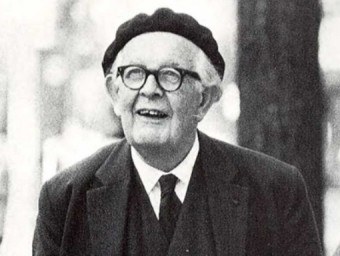 Jean Piaget
Piaget watched children playing marbles. They had worked out rules of their own and were playing by them.
But when he asked them what the rules of the game were, they couldn’t answer properly.
They had picked up the rules at an unconscious level and couldn’t put them into words. You learn unconsciously first, and only later can you state the rule.
It isn’t only children. We learn unconsciously too. Knowing how to ride a bike doesn’t mean you can explain how to ride a bike.
 Some skills, like riding a bike, you have without being able to explain them.
So we don’t hold all of our knowledge consciously and we can’t explain all of it. The unconscious patterns we pick up by watching are what culture, values, and custom are made of, and they matter even though they never show.
Enjoying this so far?
Want practical tips that make you a little smarter every week?
I cover persuasion, marketing, writing, and the other skills modern life demands.
Subscribe now and get notified when a new post goes up!
3) Stories explain the world as patterns.
All knowledge is an attempt to explain the world somehow.
These days we explain it with logic. Physics explains how objects move, biology explains life, sociology explains society. But long before humans had logic to survive with, they still had to understand the world and explain it to each other. So how do you pass on an unconscious pattern that you can’t put into words?
We learn unconsciously by watching the world, so you let the other person watch the world secondhand and learn the same way. That is a story. Humans have been recording stories for at least 40,000 years.
A story is the textbook for unconscious learning. We learn about the world through stories and we explain it through stories. A story is a unit of information.
 A story is a way of explaining the world.
So we’re stuck on stories by instinct.
Our first goal is survival, and surviving means understanding the world. As I said above, stories explain the world. Sugar is addictive because it delivers the calories survival needs, and stories are addictive because they deliver the information survival needs. The book Erzählende Affen puts it this way:
At bottom every story tells us that a problem can be solved, and exactly how the solving is done. (…) All of this explains why storytelling became our most important tool long before fire, the wheel, or weapons, (…) and why we have been telling stories for at least 100,000 years. (p. 91)
So a story is the manual for how to get through the world.
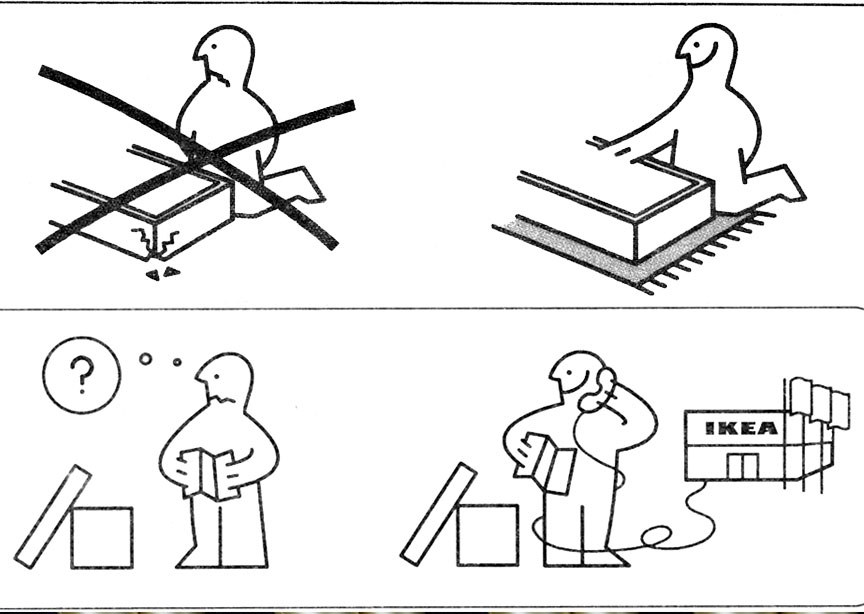 Like an IKEA manual, a story explains how you’re supposed to handle the world.
So what does a story structure that carries a pattern look like?
The American scholar of religion Joseph Campbell laid the hero myth out in twelve stages.
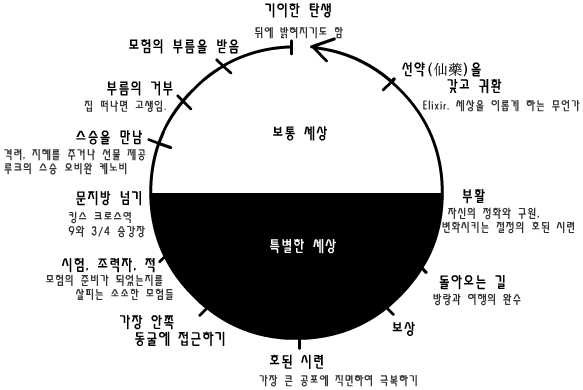 Joseph Campbell, the twelve stages of the hero’s journey, source: http://www.bhgoo.com/2011/113705
But not every story is a hero myth, and not every story carries all twelve stages. The McDonald’s worm patty story above is far simpler than that. So I looked for a structure that holds for every story, and it came down to two patterns.
Every story follows one of the two.
-
Someone did something and it turned out well.
-
Someone did something and it turned out badly.
Every narrative device and every component of a story exists to make that pattern stand out.
Why is that?
I’ll explain next week.
Subscribe and I’ll send you a notice.
Read the next post!
How to build a story that moves people - 2 - story structure and how it works
Books I mainly drew on: Story Genius, Stories That Stick, Building a StoryBrand, The Best Story Wins, 기자의 글쓰기, Erzählende Affen
Other references: the McDonald’s rumor
You might like these too!