Today I want to show you the Feynman technique, the way Nobel laureate Richard Feynman studied. This post stands on its own, but if you’re curious about why the technique works, start with the previous post! Understanding the mechanism is how you build a scientist’s knowledge instead of a chauffeur’s.
Richard Feynman had about the best problem solving and comprehension in the world. He wasn’t only good at the physics that won him the Nobel, he also solved all kinds of problems with original approaches. He found the cause of the Challenger explosion I covered last time, and he was the first to point out “the secret of the Lourdes spring” and the thought stopper from another post.
So how did Feynman study?
He described his method himself. It’s one of the most effective ways to learn, the Feynman technique. Feynman was famous for explaining complicated ideas so that anyone could follow them. Apply the method and even a hard, complicated concept becomes yours.
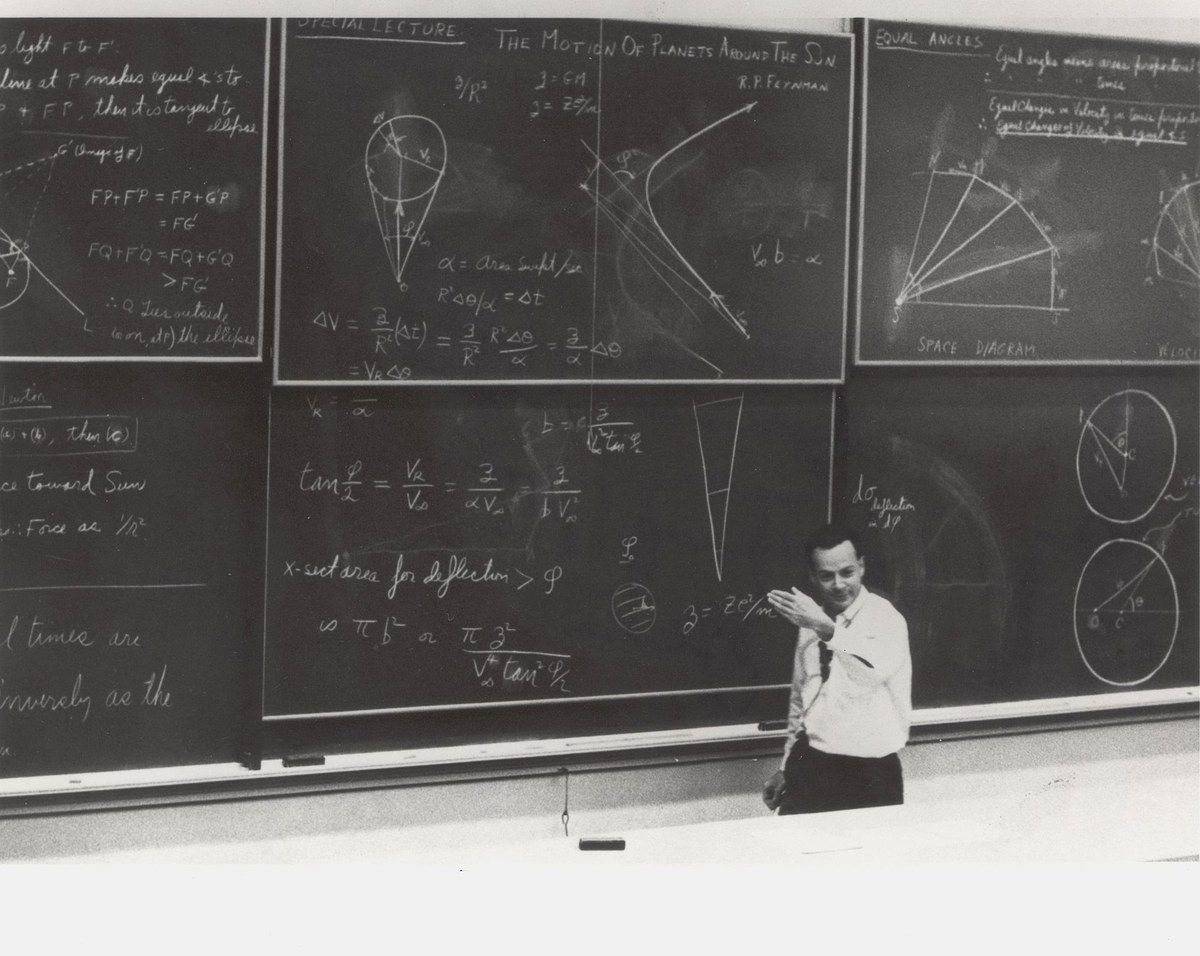 By ENERGY.GOV - HD.3A.053
What is the Feynman technique?
Einstein said this.
If you can’t explain something simply,
you don’t understand it well enough
The Feynman technique runs on the same idea. You try to explain the concept you want to learn, find the parts you can’t explain, study those, and then explain it again in your own words.
It has four steps.
-
Decide what you’re learning Pick the topic and write it on paper. Being exact about what you’re learning matters.
-
Explain it to yourself Now write out the part of the concept you already know. No difficult words, as plain as you can manage, spelled out as if you were explaining to a grade schooler. Don’t use any term whose meaning you can’t explain.
-
Look up the parts you don’t know
When the explanation stalls, go to other sources and fill the gap. Don’t stop once you’ve learned it. Write what you learned back down in plain, simple language.
- Rewrite the whole thing on a blank sheet Once you’ve repeated steps 1 to 3 until nothing is left that you don’t know, write the explanation again on a blank page, start to finish. Make it plainer and shorter than the first version. If you find a new gap, or something you’ve forgotten, go back to step 3.
When I studied for exams, for example, I wrote every topic in the exam range down on paper. Then, topic by topic, I wrote out everything I knew. Wherever I couldn’t explain something clearly, or couldn’t put it in my own words, I read the lecture notes and wrote it out again. A pass or two of that and all of it stays in your head.

Does the Feynman technique actually work?
You’re probably wondering whether it really works, and if so why. Retrieval and deep encoding, the two ideas from the last post, explain it. Memory gets stronger when you retrieve it, when you pull it up and put it into words. That lines up with the finding that explaining something yourself leaves nine times more of it in memory than sitting through a lecture. And by the deep encoding principle, an explanation that reconstructs the information lasts longer than one that recites what you learned as it was. Linking the material to your own experience, or to knowledge you already have, is what works.
The Feynman technique has one more effect, though.
Writing catches fake knowledge
As I explained in why you can’t draw a doorknob, we tend to mistake a familiar concept for one we know. So we live inside that illusion, making bad decisions on bad knowledge. Writing with the Feynman technique gets you out of it. Put it on paper and you can see exactly how far your knowledge goes and where the not-knowing starts.
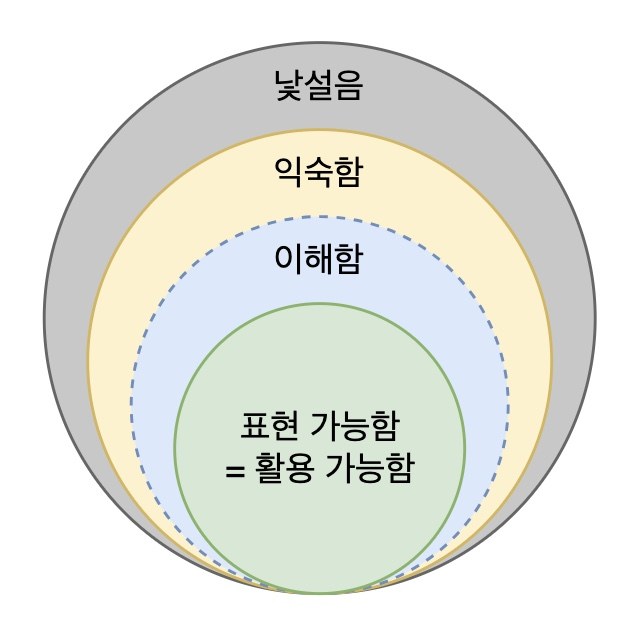 I drew this diagram myself.
Knowledge exists to solve problems. Knowledge that can’t solve a problem is the same as no knowledge. Worse than none, really. Not knowing at least leaves you room to learn, while thinking you know stops you from even trying. In that sense the illusion of knowing is its own kind of unknown unknown, and it puts you in danger. Getting past it takes an objective look at yourself, and thoughts in your head are not easy to look at objectively. That’s why you need to write them down and audit what you know.
Which makes writing a tool for solving complicated problems too. The human brain runs short on working memory and self-checking when a problem gets complicated, and writing covers the gap. I’ll go into that next time. (Follow and get the notice!)
Writing to understand
In my first post I split all writing into two kinds. 1) Writing that explains and carries knowledge, and 2) writing that carries feeling and lets you experience something. That’s two kinds meant for other people, but there’s also writing meant for yourself. One of those is writing to understand, using the Feynman technique.
Writing while you actually think about it isn’t comfortable. But as the speed reading series kept saying, you learn as much as you use your head. Not every effort is worth something, but the things that are worth something have to be worked for.
Want practical tips that make you a little smarter every week?
I cover persuasion, marketing, writing, and the other skills modern life demands.
Subscribe now and get notified when a new post goes up!
P.S. These days ChatGPT will write for you. Handing the repetitive or pointless writing to AI is fine, but writing is worth doing because the act itself is thinking, and a way of looking at yourself. We have cars and elevators, and people still go out of their way to the gym to work their muscles, right? Maybe people will end up training their brains at a gym for the mind. I don’t know what a brain gym would look like exactly, but I’m sure people will be writing in it.
References: https://fs.blog/feynman-technique/, Clear Thinking
Cover image: https://digital.archives.caltech.edu/
You might like these too!