Every phenomenon in the world has a pattern.
The most interesting ones are the quantitative relationships we walk past without noticing. From the moment the alarm wakes you up to the minute you finish the dishes after dinner, our lives are built out of countless patterns. Replacing a toothbrush on a schedule, paying a fixed installment, piling up more knowledge as time passes: these repeating and shifting relationships teach us the value of prediction, patience, and balance.
In this post I’ll go through 7 quantitative relationships we live with every day and see how they let us understand the world and get ready for the future. Learn the 7 and you learn a way to read the world and a way to predict it. Each pattern hands you one interesting lesson, too.
1. Proportional relationships: prediction
We get a year older every year, we swap a toothbrush every month, we change phones every three years, we pay the same card installment every month. Some things repeat in exactly the same shape at a steady rate.
 I changed glasses every 6 months and my phone every 3 years.
With a direct proportion like this, arithmetic alone predicts the future. You can work out how many years are left until you retire at 65. You can work out how many toothbrushes and how many razors you need in a year. A simple proportional relationship teaches us how to predict.
So is most of the world proportional? It is not. The interest landing in your account each month keeps growing, thanks to compounding. Exercise builds fitness, so your skill climbs faster the longer you go. In a foreign language, every new word you learn adds more sentences you can build than the last one did. A salary that rises by a percentage rises by a bigger amount each year. And there we find the second pattern.
2. Exponential relationships: patience
Some relationships accrue interest, like compounding, language, fitness. Getting the first crack into a phone screen is hard, but once it is there the second crack comes faster, and before long the whole screen is in pieces. An exponential relationship stays tiny at first and then explodes at some point.
 Once the cracking starts, the screen breaks faster and faster. Just like compound interest!
Humans spent most of the last 3 million years not much different from animals. We only started farming 10,000 years ago, and it has been less than 100 years since we put a satellite up.
Population is the same story. After chemistry and medicine advanced in the 1900s, population exploded. It got bad enough that Malthus worried the human race would starve for lack of food.
Look at an exponential relationship and you find a critical point. Up to a certain point not much develops, and from some moment things change fast. So until you reach that point, you cannot feel any change at all. Dabbling at exercise for a day or at English for a week gives you nothing to feel.

But exercise every day for three years and your lifespan goes up 10%, and study English for a few years and a lot of chances in life open up. Exponential relationships teach us patience.
The opposite of an exponential relationship, where the reward keeps growing, is one where the reward keeps shrinking. Say you’re learning to cook. If you can’t cook at all, knowing how to boil one packet of ramen is enough to keep you from going hungry. It makes you very happy. Now what if you know 50 dishes? You can eat something different every month of the year. Less of a jump than the first 5 recipes gave you, but you’re still getting happier.

What if you went further and learned 1,000 recipes, or 10,000? It would help a little, sure, but you wouldn’t get much happier. You have reached the point where one more recipe barely moves your happiness. Saturation. Economics calls it the law of diminishing marginal utility. And there we find the third pattern.
Want practical tips that make you a little smarter every week?
I cover persuasion, marketing, writing, and the other skills modern life demands.
Subscribe now and get notified when a new post goes up!
3. Logarithmic relationships: mastery
The exact opposite of an exponential relationship: in a logarithmic one, the gain in utility keeps shrinking. An amusement park is fun the first time or two, but go often enough and it goes flat, right? A relationship like this teaches us restraint. According to research, wealth past 1 billion won stops having much effect on happiness.
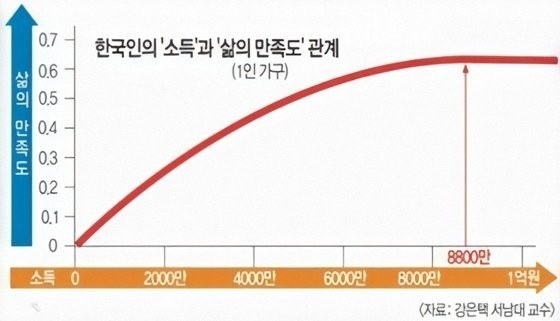 Source: http://psytimes.co.kr/skin/news/basic/view\_pop.php?v\_idx=1200
Someone with enough money has to find another route to happiness instead of earning more. Money and happiness are a logarithmic relationship.
It teaches us about getting used to things, too. The first day at the gym leaves you sore, the second day much less so, and after that the soreness keeps shrinking until you barely notice it. The way catching covid a second time is easier than the first. Anything gets easier once you are used to it, which is another logarithmic lesson.
Up to now, whatever we did, utility kept climbing or kept falling. It only moved one direction. Nothing rose and then dropped. But look at a macaron and you find that case.

Eat one macaron and you’re happy. So what happens if you eat ten more? You don’t get 10 times happier the way a proportional relationship would, and happiness doesn’t explode the way an exponential one would. It would be nice if happiness barely moved, the way a logarithmic relationship goes, but from the fifth macaron your stomach hurts and happiness falls. So here is a shape where happiness climbs and then comes back down.
4. V-shaped relationships: balance
Also called a quadratic relationship. A V-shaped relationship rises and then falls, or falls and then rises. Neither body nor mind stays healthy without enough rest, but rest 365 days a year and you end up bored and depressed instead. The right amount of dessert makes us happy, and too much clogs an artery and makes us thoroughly unhappy. A V-shaped relationship is where we learn balance.
 Balance matters.
We can be happy when we hold the right balance. 8 hours of sleep, 1 hour of exercise, 3 meals a day: the right balance is what keeps life steady and happy.
A V-shaped graph changes direction once. Reality does not. Temperature goes hot, then cold, then hot again. The seasons cycle and swing between heat waves and cold snaps. In elections the ruling party and the opposition take turns. Good days and bad days alternate. It is a relationship that swings back and forth between two states.
The next post covers the remaining four relationships, starting with the oscillating one.
Want practical tips that make you a little smarter every week?
I cover persuasion, marketing, writing, and the other skills modern life demands.
Subscribe now and get notified when a new post goes up!
References:
- A study on the relationship between income and happiness (Ko Hye-jin, Jung Hae-sik)
You might like these too!