This is a way of reading for people who want to write well.
Part 1 gives you what you need to follow this one.
I would read that first.
Part 1 link: <The way of reading only good writers know, part 1>
Critical reading practice: Vice Chairman Lee Jae-yong’s apology
Here is the example I promised in part 1. It is a famous one: the apology Lee Jae-yong, then vice chairman of Samsung Electronics, gave during the MERS outbreak. (Put aside how you feel about him and look only at the writing.)
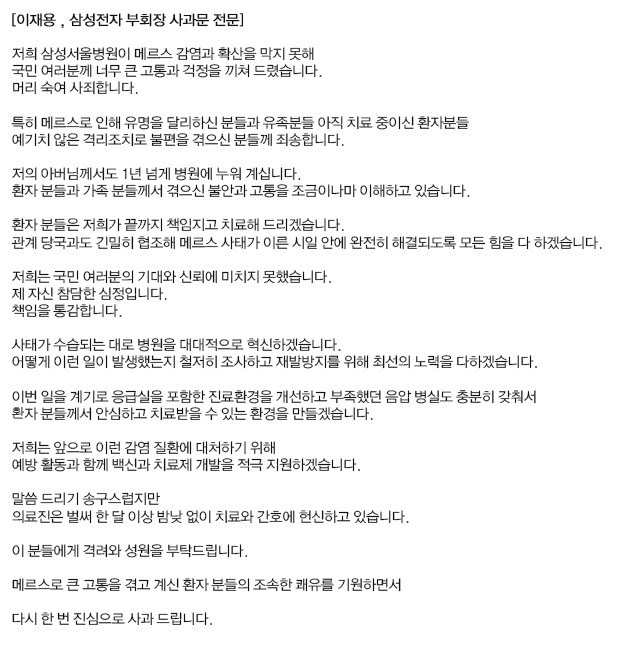
How was it? Try reading it out loud.
Any sentence that made you feel something? Underline it and think about why.
(If you are on a phone, drag across one sentence at a time and analyze it that way)
This apology is plain and carefully built, and reading it calms you down.
You also come away feeling that the staff at Samsung Medical Center have been through a lot.
I have read this apology more than fifty times, analyzing it line by line.
Let’s go through how it was built, one line at a time
Critical reading analysis: Vice Chairman Lee Jae-yong’s apology
Start with the first line. It admits fault and apologizes right away, with nothing else in front of it. It names the specific failure (not stopping the infection and spread of MERS) and the specific harm (the suffering and worry of the public). The next paragraph apologizes again, naming the dead, the infected, and those in quarantine one by one. Because it opens by apologizing for every piece of it, it is hard to come away thinking the apology fell short.
Then it expresses sympathy and confirms that the apology is sincere. Instead of simply claiming “I understand how you feel,” it mentions his father to show how much he understands what the victims are going through. He expresses sympathy by pointing at his own family’s suffering, which is why it reads as sincere.
Alongside that sympathy, the apology repeats itself in the language of feeling: responsibility, promise, hope, trust.
After apologizing in the language of feeling, it lays out its response in the language of reason. Investigation, a better care environment, more equipment, support for a vaccine, concrete actions. So the emotional apology comes first and the rational one second. And because those measures apply to each group named earlier, the dead, the infected, and the quarantined, the response reads as sufficient.
As the analysis shows, the apology speaks in both languages, feeling and reason. It settles the people who are angry and the people who simply don’t trust the company. The urge to blame softens too.
Then it carefully brings up the medical staff and asks you to encourage them. It describes them concretely, working day and night for more than a month. People are having that hard a time, and you feel for them. Why does it land that way?
First, because it describes. A month of devotion, day and night, puts the strain in your head. You can see the same power of description earlier, in the line “My father has been lying in a hospital bed for over a year.”
Second, because of where the sentence sits. The apology, the sympathy, the emotional apology, and the rational one have already settled the urge to blame, so by the time this comes up the reader can feel for the staff. Move the appeal for the staff to the front of the apology and it reads like dodging fault. Here it waits until the reader has cooled off, then shows briefly that the work is still going on. So the reader can sympathize with the staff, and might even end up rooting for them and the hospital. Stopping the blame and turning it into support inside a short apology is skilled work.
After drawing out that sympathy, it closes with one more apology.
What stays with you is the last thing you read. A short apology held a lot, sympathy, promises, an appeal for the staff, but because it ends on an apology, the apology is what you remember. That is the right ending for what the piece is for.
You don’t have to go this deep, of course.
Catching one or two things in the whole piece is already good! Everyone feels something different, and there is nothing odd about that.
Just keep asking, while you read, which parts work and which don’t and why, and the analysis gets more detailed over time.
 Best of all is analyzing with a pen in your hand
Now you can do it too
So ask how a piece of writing produces its effect. Practice critical reading line by line.
Analyze line by line and you can also judge how a reader will feel reading your own writing.
Whether this story will catch attention,
whether this evidence will persuade,
whether this metaphor will make it clear,
you can judge with confidence.
Once you can judge, writing is the easy part.
You can write promotional copy that lifts sales, an application that gets you hired, an apology that gets forgiven, a story people sink into.
So read, ask, and answer.
The next post covers how to write well. It is not far from how to read well.
Think you know it already? Follow and I’ll let you know when it’s up.
P.S. If the apology above really interested you, try these questions too.
-
Why does the emotional apology come before the language of reason? What would be different if the order were reversed?
-
How are the two promises presented, improving the care environment and supporting the development of a treatment? If those promises land with you, which part of them does it? Why does the apology not name a funding figure or a number of beds to be added? How would the piece feel if it did?
-
The piece apologizes three times. What exactly is it apologizing for? Does it say the hospital did wrong (잘못했다), or that the hospital did not do well (잘 못했다)? How do those two differ?
Any answer is fine. If you find your own, I would like to read it in the comments.