What makes someone a winner? The person who won, right?
Whether it came from natural talent, the household they were born into, effort, or plain luck, we call someone a winner when they’ve beaten other people at something. And we seem to live in a society where competing and winning is simply assumed: at school, at work, in salary, in what you own.
But is winning actually good for you?
Not always. You can win a competition and still lose. Peter Thiel, who founded PayPal and Palantir, gave a talk titled “Competition is for Losers,” and it points at something more important than winning.
To get there, we have to pull competition and reward apart first.
A Pyrrhic victory
The standard example is the Pyrrhic victory: you win, but the win costs so much that you gain nothing from it. Pyrrhus, the ancient Greek king, beat Rome at enormous cost and is said to have remarked that one more victory like that would finish them off entirely. Wins and gains come apart like this more often than you’d expect.
In the talk, Thiel points out that the US airline industry has made almost no profit over the past hundred years. In 2012 alone the industry generated 195 billion dollars in domestic revenue, and the airlines kept essentially none of the value they created.

Google, by comparison, created 50 billion dollars that same year with a profit margin above 20 percent. Google’s market cap ended up more than three times the combined market cap of all US airlines. Put simply, the airlines are playing a game four times the size of Google’s and taking nothing home from it. A bigger competition doesn’t hand out a bigger reward.
Thiel sums it up like this: a company creates X dollars of value for the world and captures Y percent of that value, and X and Y are independent variables. You can win the most brutal competition around and end up with nothing. So why do people keep walking into this trap?
Want practical tips that make you a little sharper each week?
Persuasion, marketing, writing: the skills modern life keeps asking for.
Subscribe and get a heads-up whenever a new post goes out!
Competition as a fashion
Thiel says people are imitative by nature. We pile into whatever competition looks popular, and that’s how crowds end up in bad games like the airline business.
But a good competition might be one with few competitors, or one you can monopolize outright. So the ability to pick which competition to enter matters more than the ability to win. (According to the talk,) the hard disk industry of the 1980s attracted enormous investment and innovated quickly, but plowed its earnings back into development and made little money in the end. Plenty of early American railroad companies competed their way into bankruptcy too. Competition drives innovation and creates value for society, but for the individual who enters it, it is a loss and a tragedy.

The real winner of a game isn’t the one who comes out of it covered in blood. It’s the one who found a game they could actually win (their circle of competence) and pulled as much out of that game as possible. Hence: competition is for losers, and you should be monopolizing instead.
The stock market shows this about as plainly as anything can. The famous names keep changing, Palantir, Tesla, whichever is next, but the people who make money bought before the name got famous and sold once it was. (Day traders aside.)
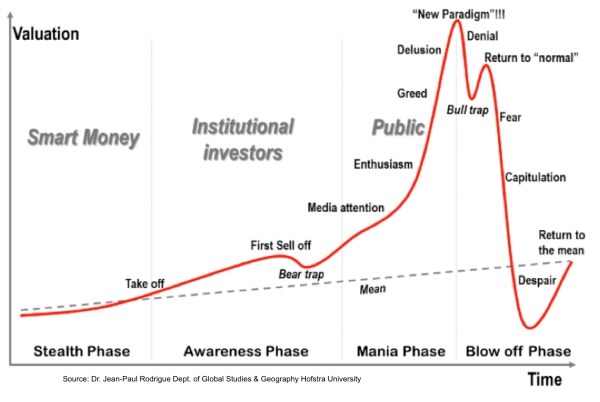 What an investment bubble looks like
Simply put, fame, whether a stock’s or a competition’s, is a reason to find it less attractive, not more. But we’re wired to like whatever is popular. That instinct is the thing you have to beat.
Avoid the competition and monopolize the right market. So how do you do that?
The last mover
Thiel says a monopoly needs two things: overwhelming superiority, and a monopoly that grows. PayPal’s payment speed and Google’s search quality were about 10 times better than the alternatives. Ten or twenty percent better leaves you in a fight. Ten times faster gives you a real shot at owning the market. The other half is starting small and monopolizing outward, avoiding competition along the way. “Go after a big market” is common sense, but it also means fighting a huge competition from day one. These companies took over small markets nobody was paying attention to, one after another, and that’s where the value came from. Amazon started as a bookstore. PayPal started with a market of 20,000 people. Facebook started with Harvard. Then they took the whole world. The cleantech companies and the railroads went the other way, starting in a big fight and finishing it with little to show.

The last mover advantage matters too. Most people assume you want to be the first mover, the first player into the competition, but the profits go to whoever is still standing at the end and stays there. Meta won the social network fight and became the last social network. Microsoft became the last operating system. A lot of AI services are competing right now, and my guess is the last company left will make the most money.
So: avoid competition, and monopolize small markets one step at a time. Instead of the competition everyone is in, look for the one nobody is in. The answer is in the ability to create something new, which is the zero to one ability Thiel keeps coming back to.
A society with many games, and pluralism
Choosing a good competition matters more than pulling ahead in whatever competition you’re already in. Which means the more good competitions a society has, the more innovation and the more winners it can produce. And for many kinds of competition to exist, many kinds of values have to be accepted. To see why that follows, we need to look at pluralism.
Next week, let’s look at what pluralism actually is. Subscribe and I’ll let you know when it’s up.
Want practical tips that make you a little sharper each week?
Persuasion, marketing, writing: the skills modern life keeps asking for.
Subscribe and get a heads-up whenever a new post goes out!
Source
You might like these too!