<The momentum that pulls a reader in>
Easier to follow if you start from part 1.
Last time we looked at two ways to build momentum (make a reason and shake up an emotion).
But however strong the momentum you build in the opening, it drains away as the reader goes. Let’s look at how to top it up along the way.
3. Space the hooks closely
Back to the car. On a hill, a car that doesn’t get the pedal pressed every so often stops before it gets far. A reader stops the same way once the momentum is gone, so you have to refill the interest as you go.

Place interesting bits through the piece and the reader has the strength to keep going even in a long one. Alternate what we want to say to the reader with what the reader wants to hear.
This is where it differs from the intro/body/conclusion structure. There, the reader’s attention gets pulled in the intro, and the body and conclusion are the writer saying what they wanted to say. That only works when the piece is very short. Especially in an age of Reels and Shorts and TikTok, people can’t hold their attention for a minute.
 https://www.goldenstepsaba.com/resources/average-attention-span
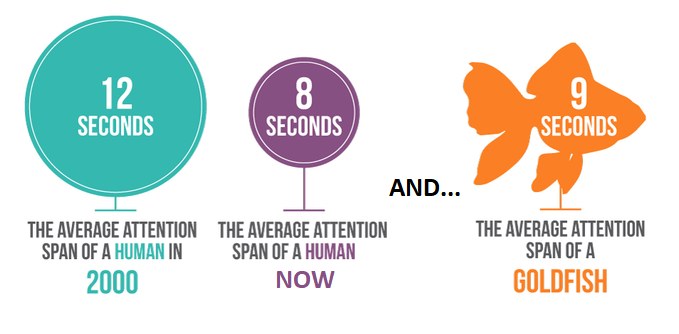
Average attention span in the 2000s: 12 seconds. In 2022: 8 seconds. Shorter than a goldfish, apparently.
Online, where a reader’s attention runs especially low, you have to pull that attention back every ten sentences or so with an image, a story, a one-line summary, a paragraph break. This is a world where people won’t read without a three-line summary. Readers hold less attention than you think. Space the interesting bits closely through the piece.
So once you’ve gathered all this momentum, what should you spend it on?
What is momentum for?
It isn’t what this post is about, but since momentum has come up, I’ll cover it briefly. As I keep saying, we write to change the reader. Momentum is the fuel for changing them. There isn’t much of it, so spend it carefully. To spend it well, the message of the piece has to be simple. (I explained how to set that message, the purpose sentence, earlier.)

Once you have your one message, vary it. Variation means repeating a melody while changing it a little each time. Writing works the same way. Pick one message and deliver it over and over in different forms, and the reader changes. First as a question, then as a story, then by setting off surprise or anger or curiosity, repeating the message of the piece without stopping. Only after our message reaches the reader that many times does the reader change. Why vary it, though?
Because a person changes when the same thing reaches them in many forms. Tie one message to different emotions and stories and tell it that way, and the reader starts taking it as true. I’ll come back to this another time. For now, just note that repeating strong emotion and story is what persuades.
People take a message in best when they’re completely absorbed. Their attention is high, so they follow what the piece says, and because they’re absorbed, they accept it without pushing back. So if you want to change someone, first get them fully focused. A reader whose momentum is filled up with curiosity, reasons, and story is a reader in the best state to be changed.
If you just thought, wait, is momentum a technique for casting a spell on people, then you’ve worked out what this post is really about.
Be a good attention seeker
We call someone who acts out an attention seeker. There’s something negative in the phrase.
But every piece of writing has to get attention. However sincerely and however hard the writer worked, it’s worth nothing if the reader looks away.
Getting attention doesn’t make you an attention seeker. You get called one when you grab the attention and there’s nothing inside.
So grab the attention however you can, then hand over something useful. Someone who can’t even manage to be an attention seeker has no power at all.
Be the good kind of attention seeker.
Books referenced
강사의 탄생
100만 클릭을 부르는 글쓰기
끌리는 문장은 따로 있다
Building a StoryBrand
P.S. One very good way to build authority is to leave out where your information came from. It makes you look like someone who knows a strange and important secret. That’s why so many people hide it. But without the source, it’s harder for the reader to think further and dig on their own. So I list the books I used. I read and thought and then wrote this, and I’d like readers to read and think and write too. You can hand the laundry to a washing machine, the cleaning to a vacuum, the cooking to a microwave, but thinking is the one thing you must never hand off.